Share on social media
Share
Tweet
Publication date: March 12, 2026
Author: Link Platform Content Manager Valentina Chabanova-Babak
The Legal Development Network, in cooperation with the Czech humanitarian organization People in Need and with funding from the UK government, helped the Shevchenkivska Hromada in Mykolaiv oblast develop a Strategy for Responsible Partnership and Conscious Living in the Hromada. Such a document is a new phenomenon for Ukraine. We spoke with Ruslan Bakhtiev, head of the Garnet social technology studio, candidate of political sciences, strategic development coach, and facilitator who worked with the hromada on creating the Strategy, about what this strategy is, why the hromada needs it, and what functions it will perform.
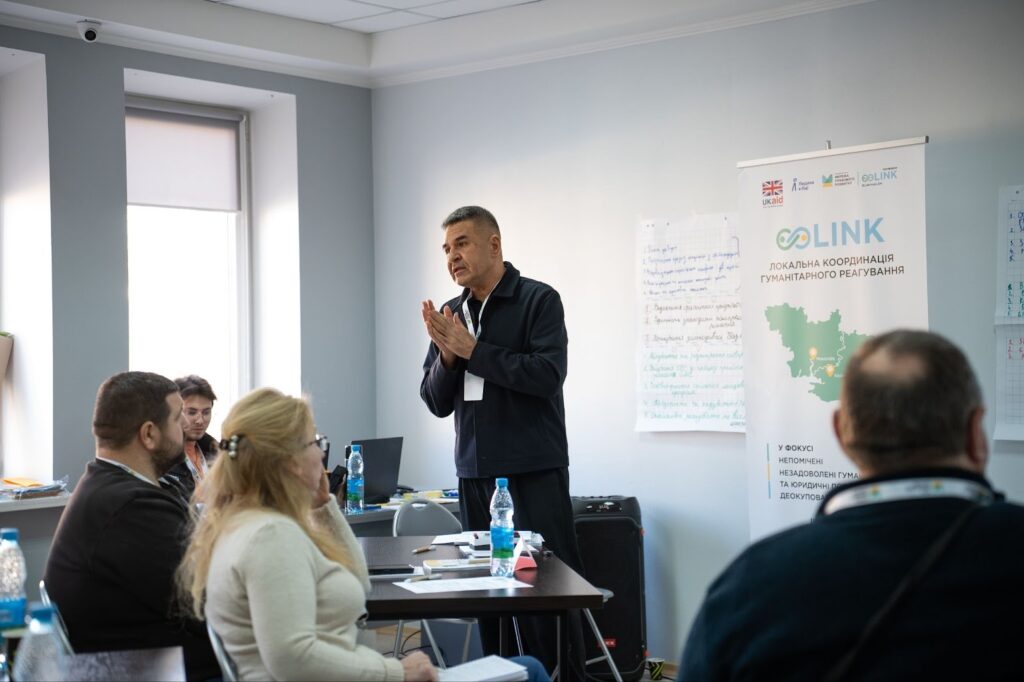
Head of Garnet Social Technologies Studio, PhD in Political Science, Strategic Development Coach, Facilitator Ruslan Bakhtiev
— Ruslan, what is the Strategy for Responsible Partnership and Conscious Living? Why did the idea arise to develop it for the Shevchenkivska Hromada?
— The strategy consists of three components: partnership between different parties, responsible living, and transforming the territorial hromada into a local hromada. I worked with the Shevchenkivska Hromada at the beginning of the project — three years ago, we created the Hromada Development Strategy together. So I was very happy when the hromada supported the Legal Development Network’s proposal to work on the Strategy for Responsible Partnership and Conscious Living. The Shevchenkivska Hromada already has considerable experience: it is a professional, development-oriented team. While working on the new strategy, the key questions were: how to help the Hromada build a model of responsible partnership, what should it look like in practice, and how to involve every resident in conscious living in their hromada? I was personally very inspired by the example of hromads in Scandinavian countries. There, every resident does some volunteer work outside of their main job: some distribute food to the homeless, others help out at school. People choose areas based on their interests, get involved in socially important causes — and this becomes the norm. So, the question arose: can we implement a similar model here?
— Who participated in the strategy development?
— Local government bodies, businesses, the public sector, and local residents. Our task was to involve as wide a range of participants as possible to ensure that all four key hromada’s actors were fully represented. For example, among civil society organizations, there were those that regularly cooperate with local authorities and those that do not have this experience; among businesses, there were representatives from various sectors. After all, in hromads, partnerships and interactions are often limited to a very narrow circle — a kind of closed group of “trusted” individuals, which includes representatives of the authorities and some businesses and the public sector who are already used to working together. The problem is that other entrepreneurs, civil society organizations, and a large part of the population — between 60 and 80% of the Hromada — remain outside this circle. When so many people are excluded from decision-making processes, stereotypes arise that “the authorities do nothing” and that civil society activists are “grant seekers.”
— So, all the actors were represented as widely as possible. And how did the work itself take place?
— The strategy process lasted three days. During the first two, all the actors worked together. We determined the role of each of them in influencing the development of the Hromada: how exactly local governments, business, the public sector and local residents influence each other. Then we analyzed the interests of each party and looked for common ground. We also talked about responsibility and possible threats. After all, when one of the parties starts any project, this is actually an intervention in the lives of the others. If you discuss the interests of each party in advance, understand how they might perceive our idea, proposal or action, a completely different level of communication arises. These are not easy conversations, but it is extremely important to have space for them.
— Can you give an example from a specific area?
— Often people working in the same industry — say, in economics — see the situation completely differently. A local entrepreneur, an economist from the executive committee, and an employee will talk about different things, taking into account their needs and experience. It was very interesting to watch how representatives of all sides of the Hromada gathered at one table. Despite daily interaction, such joint work was a real discovery for them. Even Head of the Hromada, Oleg Pylypenko, admitted that he had previously been convinced that the interests of certain groups lie on the same plane. During the dialogue, it became clear that this is not at all the case. This awareness fundamentally changes the approach to work. Such a format helps to destroy stereotypes that have been formed over the years. When healthy interaction is established in the Hromada, it is much easier to promote innovative ideas. Participants reach agreement faster, because they have experience in dialogue, the necessary knowledge, and, most importantly, a common practice of negotiating on equal terms.
— What about the local residents? Were they involved in the discussion?
— Part of the third day we worked only with local residents. It was important to give people space to talk without the participation of local government bodies and other actors. So that they could talk about how they see the meanings of living together in the Hromada and be able to voice them. Here, the key task was to move from a paternalistic attitude to responsibility.
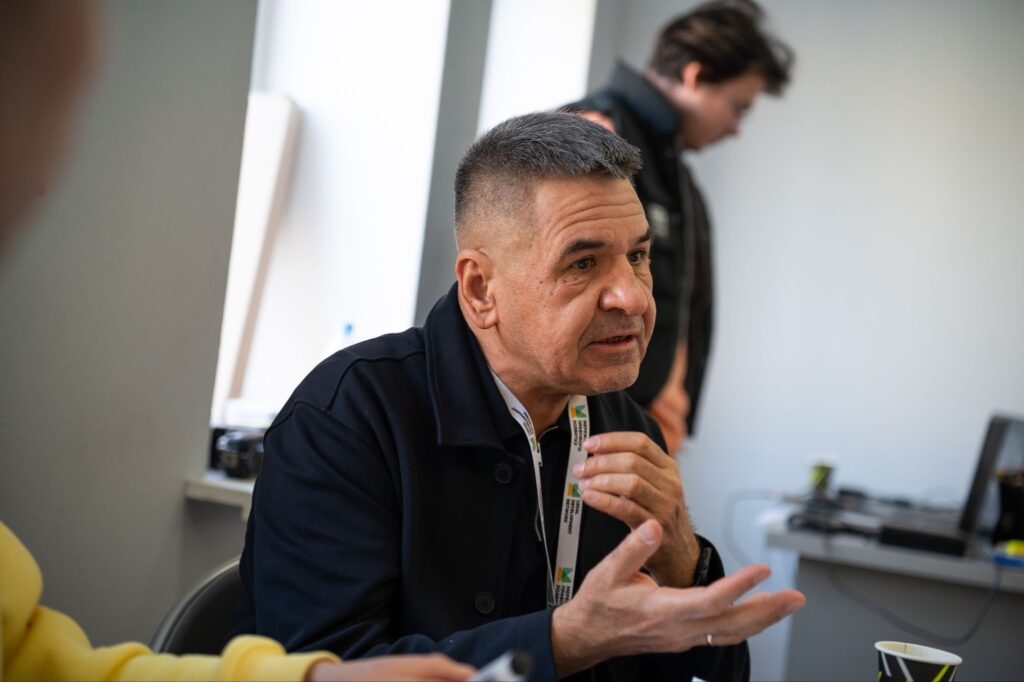
Ruslan Bakhtiyev while working on the Strategy
— Did the local authorities see the potential in closer interaction with residents?
— Thanks to the joint dialogue, the idea of the role of people in the Hromada is beginning to change radically. The local authorities saw that residents should not be perceived as a “burden”, as those who only complain, express dissatisfaction and constantly expect help. Instead, their real, previously unrealized potential was revealed. This experience once again confirmed how critically important strategic communication is. Any initiative should be developed and presented in such a way that it does not look like an action solely in the interests of officials or entrepreneurs. Each resident must clearly see and understand: “This is being done for me too.” Only such an approach — based on transparency, consideration of interests and trust — makes it possible to overcome chronic distrust and form a sense of shared responsibility for the future of the Hromada.
— What next? Who will support this dialogue and partnership?
— First, the Hromada will receive a document that will record the principles developed over three days of work. As for further meetings, in this case, the local authorities took responsibility. Its representatives noted that they saw the benefits of joint work and are ready to continue in this format. At the same time, the question of the mechanism — how exactly this will happen — remains open for now.
— Can this experience be extended to other hromads in the country? If so, how exactly?
— Of course, each hromada can form its own sense of responsible living. For hromads in the west of Ukraine, this may mean, for example, greater attention to landscaping, the development of cultural events, or interaction with internally displaced persons. On the other hand, hromads in the South are currently in a different context, as they live under constant shelling.
— Is it important to work on such strategies right now? We are currently at war, one would think that the priorities would be different.
— We receive significant support from international partners: to strengthen local governments, develop the capacity of civil society, and support business. At the same time, we pay much less attention to ensuring that residents themselves move from paternalistic attitudes to personal responsibility for life in their Hromada. And this is extremely important. It is about the common being perceived not as “someone’s” or simply “public”, but as “mine” — something for which I am also responsible.
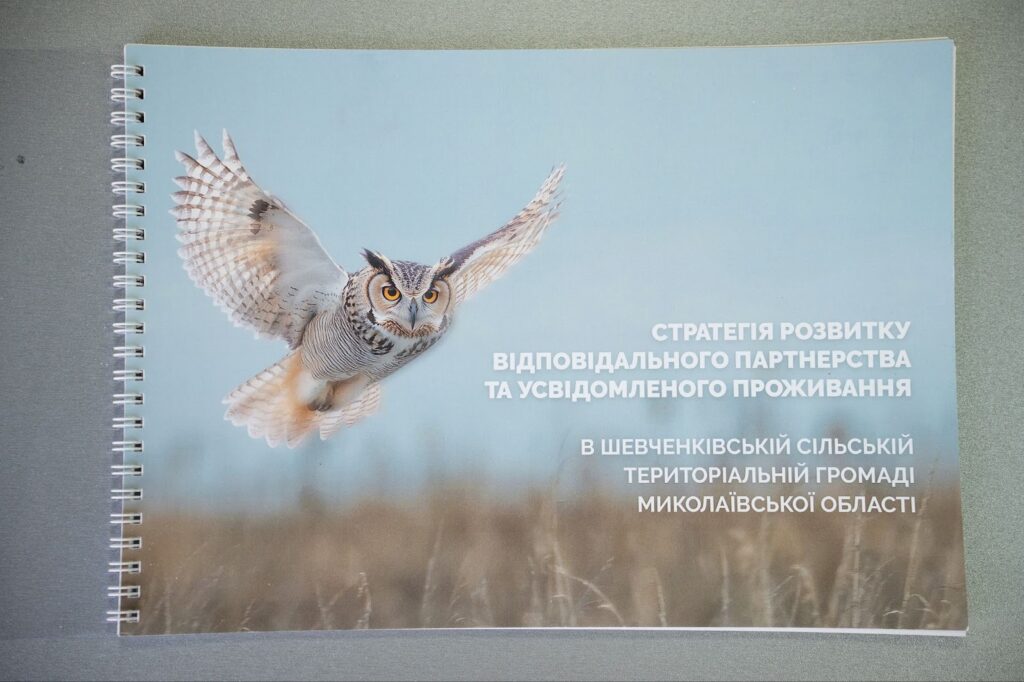
The printed format of the Developed Strategy for Responsible Partnership and Conscious Living in the Shevchenkivska Hromada
The material was prepared by the Legal Development Network in cooperation with the Czech humanitarian organization “People in Need” and with the financial support of the UK government.
P. S. In June 2024, the Legal Development Network (LDN) launched a crowdfunding campaign, Recovery of The South of Ukraine , as part of the crisis response program #StandWithUkraine.
You can Recovery of The South of Ukraine |
If you have notices an error on the web-site, please, highlight the text and press ctrl-enter.
Print and place the Network's poster on a notice board in your entrance hall
Become a volunteer and assist others in finding problem solutions
0 800 331 113
from 10:00 to 17:00, toll-free within UkraineAsk a question, and one of the Network's experts will provide an answer.
Chat hours: daily from 10:00 to 16:00.
Ask questions via LawLink Bot in any convenient way. LawLink Bot is a smart and digital legal assistant created by the Legal Development Network.

The Legal Development Network implements comprehensive projects aimed at strengthening human rights, developing capable communities, and building sustainable tools for access to legal aid. We work at the intersection of advocacy, legal education, and local coordination of humanitarian response.

Support free legal aid in Ukraine. Your donation helps people affected by the war defend their rights in court and beyond.