Share on social media
Share
Tweet
Publication date: August 17, 2026
54,832 beneficiaries, 63,943 cases, four channels of access — from field sessions in the de-occupied hromadas (communities) of the South to consultations for Ukrainians in Canada and Poland. We examine what the Legal Development Network’s data for the first half of 2026 show, and why the most widespread obstacle to protecting rights remains the absence of an entry in the register of property rights.
Mariia* came to the lawyers of the NGO Strategies and Technologies of Effective Partnership in Zaporizhzhia. Her house had ended up in territory controlled by Russian occupying forces. She held the original document confirming her ownership — an old paper document issued before 2013. Her right was not recorded in the State Register of Property Rights to Immovable Property.
Before 2013, real estate was registered by bureaus of technical inventory (BTI), and those records were not transferred to the electronic register automatically. To enter the information now, a state registrar is obliged to obtain confirmation from that same BTI. The BTI archive remained in occupied territory. Obtaining a response is physically impossible — and the woman was refused the administrative service.
What followed is described by the organisation as a lottery: court practice in different regions of Ukraine diverged, and owners could not work out how exactly to defend their rights — through civil or through administrative proceedings. Mariia went through refusals by civil courts, which considered the remedy she had chosen inappropriate, while in other oblasts, in analogous circumstances, courts ruled in favour of owners. The organisation’s lawyer changed strategy, moved the case into administrative jurisdiction, and the case had to be taken all the way to the court of cassation.
This story comes from Zaporizhzhia. But it is repeated almost word for word in the aggregate data of the LINK legal component in Kherson and Mykolaiv oblasts, where lawyers record wording such as: owing to the absence of title documents for the housing, the beneficiary is unable to carry out state registration of ownership in the State Register of Property Rights to Immovable Property, and in addition cannot submit an application for compensation through the Diia app.
At issue is one and the same problem, which defines a significant share of wartime legal needs: the right exists in fact but does not exist on paper — while every modern support mechanism, from compensation for destroyed housing to inheritance, is built on an entry in a register.
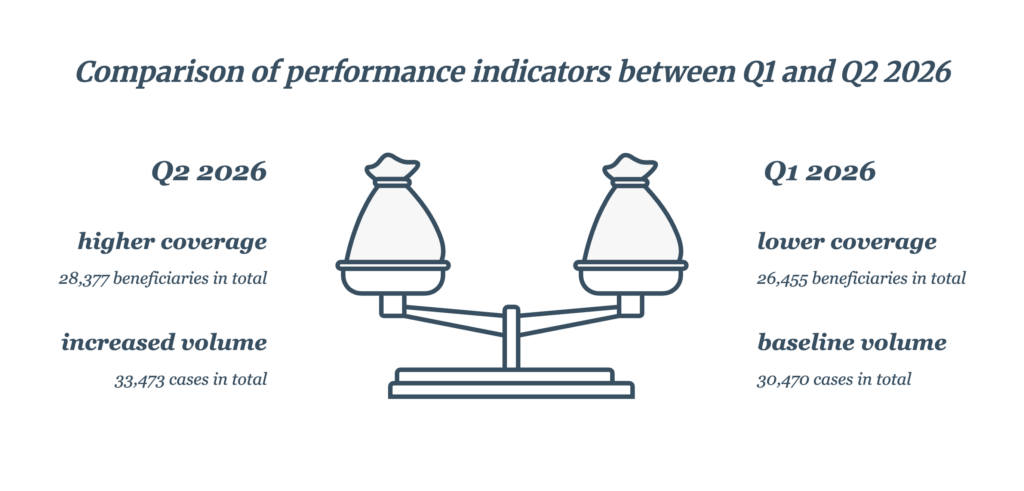
In the first half of 2026, 18 member organisations of the Legal Development Network provided free primary legal aid to 54,832 beneficiaries in 63,943 cases. The breakdown by quarter: 26,455 beneficiaries and 30,470 cases in January–March, and 28,377 beneficiaries and 33,473 cases in April–June. Growth in the second quarter was 7.3% in the number of people and 9.9% in the number of cases.
The ratio of in-person to remote reception is almost equal: 31,206 beneficiaries (56.9%) received assistance in person and 23,626 (43.1%) online, not counting the online chat.
It should be noted that the Charitable Foundation Right to Protection assisted 47,204 beneficiaries, or 86.1% of the Network’s total figure. This organisation has greater capacity and wider geographic coverage than the other Network organisations. In the analysis that follows, the key breakdowns are therefore given separately — with and without this organisation.
Excluding the CF Right to Protection, 17* organisations provided assistance over the half-year to 7,628 beneficiaries in 9,558 cases. The geography of these organisations covers most of the country’s oblasts. Front-line and de-occupied oblasts are represented by the NGO Time to Gather Ukrainians (Mykolaiv), the NGO STEP (Zaporizhzhia), the NGO Agency for Democratic Development of Donbas (Sloviansk, relocated to Dnipropetrovsk Oblast) and the NGO Public Platform (Sievierodonetsk, relocated to Kyiv Oblast). The northern border oblasts are represented by the NGO Northern Human Rights Group (Sumy) and the Chernihiv Public Committee for the Protection of Human Rights (Chernihiv). The west and centre — by organisations from Khmelnytskyi, Kamianets-Podilskyi (Khmelnytskyi Oblast), Vinnytsia, Khmilnyk (Vinnytsia Oblast), Bila Tserkva (Kyiv Oblast), Kolomyia (Ivano-Frankivsk Oblast), Sheptytskyi (Lviv Oblast) and Chernivtsi. This distribution means that the Network’s aggregate figures combine fundamentally different types of demand: from formalising statuses for displaced persons in the rear areas to documenting the consequences of temporary occupation.
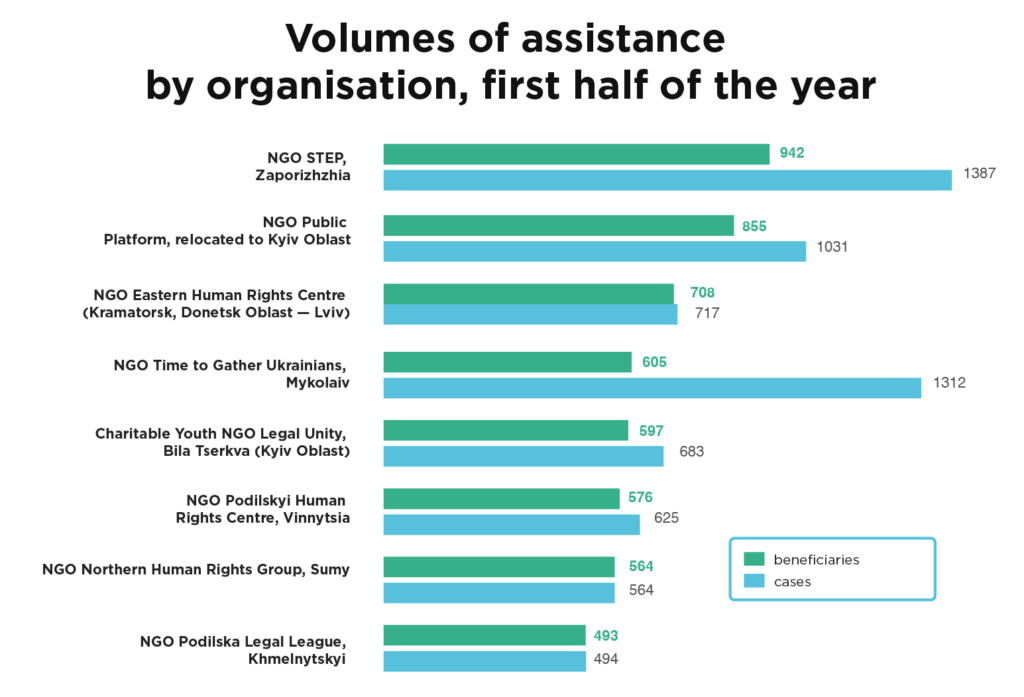
The leaders by volume are the NGO STEP from Zaporizhzhia (942 beneficiaries, 1,387 cases) and the NGO Public Platform from Kyiv (855 and 1,031). The highest number of cases per beneficiary is found in the practice of the NGO Time to Gather Ukrainians, Mykolaiv: 605 beneficiaries and 1,312 cases, that is, on average more than two cases per person — twice the Network average (1.25).
Secondary legal aid — 4,444 cases over the half-year — accounts for around 7% of the total number of cases. In other words, for every fourteen consultations there is one instance of representation or full case support. This ratio reflects the Network’s model: broad access to primary assistance, with selective in-depth support for those cases that would not be resolved without it.
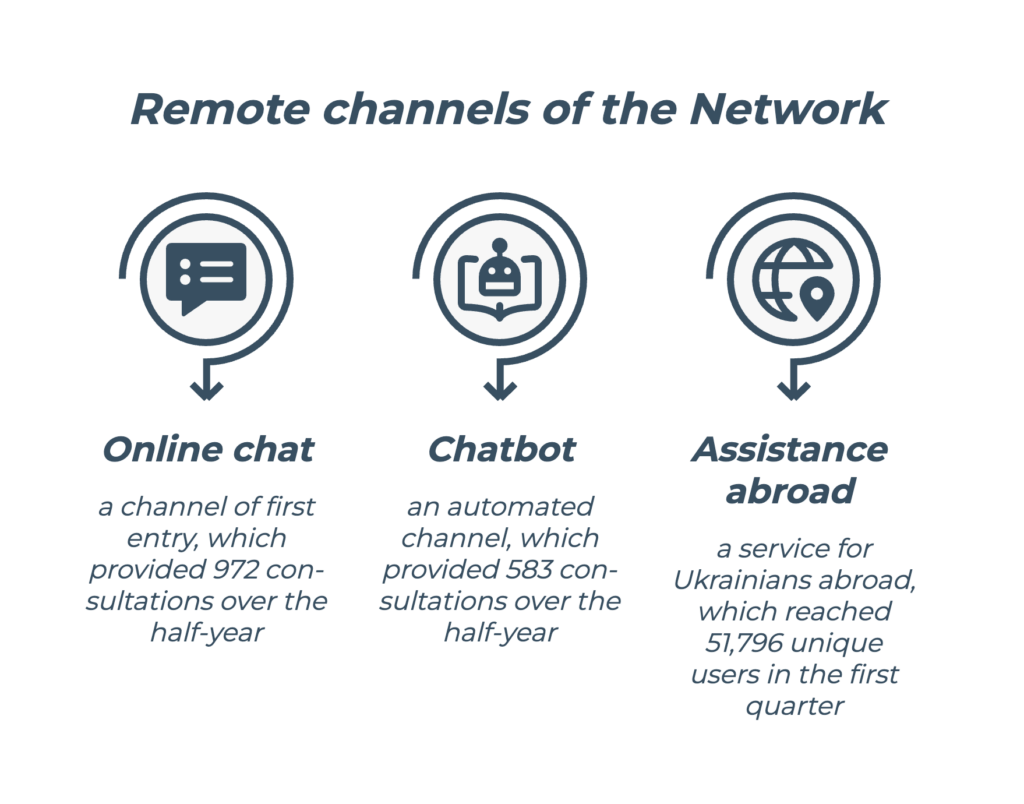
Alongside in-person reception, the Network operates through three remote channels, and each of them serves a different audience.
Remote channels of the Network, first half of 2026
| Channel | Q1 | Q2 | Total |
|---|---|---|---|
| Online chat (consultations) | 489 | 483 | 972 |
| Chatbot (consultations) | 275 | 308 | 583 |
| Service for Ukrainians abroad: consultations started, total | 167,083 (+4%) | 169,589 (+1.5%) | — |
| Service for Ukrainians abroad: consultations completed | 113,545 (68%) | 76,315 (45%) | — |
| Service for Ukrainians abroad: unique users | 51,796 (31%) | 46,783 (28%) | — |
As of 12 August 2026, 1,125 consultations had been provided through the Network’s online chat, reaching 919 people, of whom 861 were new users. That is, 98.6% of chat users were making contact for the first time. This is a channel of first entry rather than of ongoing support: people come with a single question and do not return.
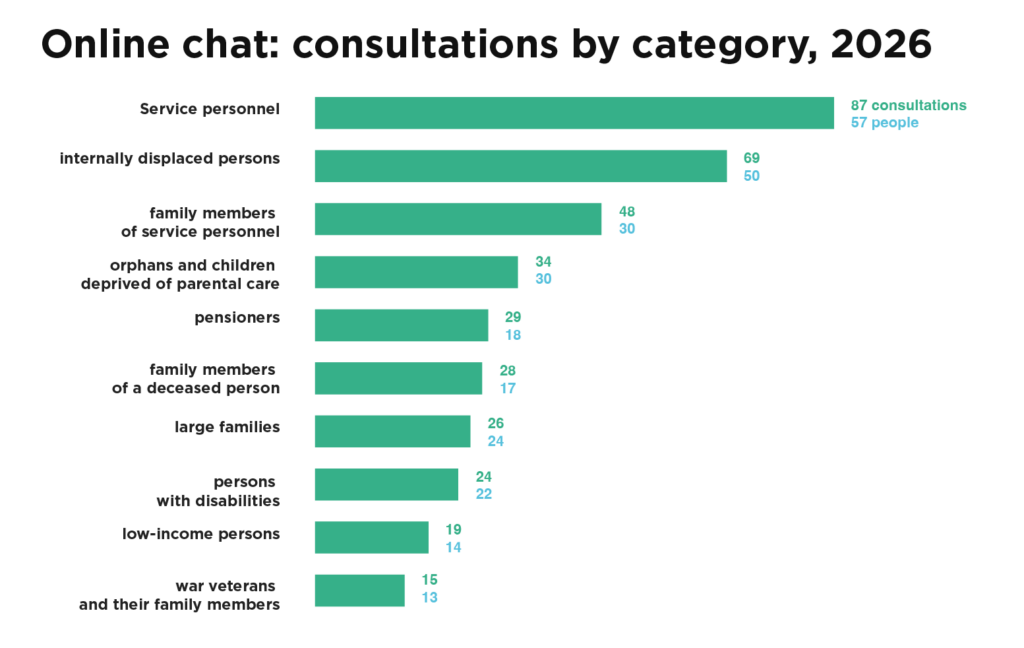
The profile of chat users differs radically from that of a visitor to a field session in the South. The largest category is service personnel (87 consultations, 8.3% of the total), followed by internally displaced persons (69, 6.6%), family members of service personnel (48, 4.6%), and orphans and children deprived of parental care (34, 3.2%). Pensioners account for only 29 consultations, or 2.8%.
It should be noted that a status category was recorded for only 410 consultations out of 1,048, that is, for 39%. The remaining users either do not belong to any privileged category or did not indicate one. This in itself is telling: the online chat serves the general population, whereas field reception targets vulnerable groups specifically.
The service for Ukrainians abroad, which the Legal Development Network has run jointly with Lingo since 2022, was approached by 51,796 people in the first quarter of 2026 and by 46,783 in the second (down 28%).
In the second quarter, 61% of consultations in the service for Ukrainians abroad concerned employment, 30% taxation, 28% housing rental, and 15% each education and status. By country, the leaders are Canada (35%), Poland (31%), Austria (16%), Spain (10%) and the United Kingdom (8%). There is a noticeable shift between the quarters of 2026: Poland’s share fell from 41% to 31%, while questions about education rose from 8% to 15% and questions about status fell from 21% to 15%. This is consistent with the logic of a prolonged stay: acute questions of legalisation give way to questions of settling in.
The legal component of the LINK mechanism, which the Legal Development Network has administered since 2024, operates on a fundamentally different model — visits by lawyers to settlements in the de-occupied hromadas of Kherson and Mykolaiv oblasts. In the first half of 2026 it recorded 175 requests from 159 beneficiaries in 33 settlements of 16 hromadas.
In absolute terms this is not comparable with the figures of the member organisations. But a direct comparison would be incorrect: LINK records not the requests a person brings to a lawyer, but the needs identified on the ground. 77.1% of requests were recorded during field visits. Without the physical presence of a lawyer in the village, these needs would not have entered the statistics at all.
The first thing that changed in 2026 is geography. Whereas over the whole observation period requests were distributed almost equally between the two oblasts (409 from Kherson Oblast and 395 from Mykolaiv Oblast), in the first half of 2026 129 requests came from Mykolaiv Oblast hromadas and only 45 from Kherson Oblast. This is a consequence not of a change in demand, but of a change in the intensity of field work driven by the security situation: visits to front-line hromadas in Kherson Oblast have become more difficult.
The second is a sharp increase in the need for referral to partner organisations: 39.4% of requests, against 23.4% over the whole observation period. This means that the structure of cases is becoming more complex: matters that were previously closed with an on-site consultation increasingly require court proceedings or full case support.
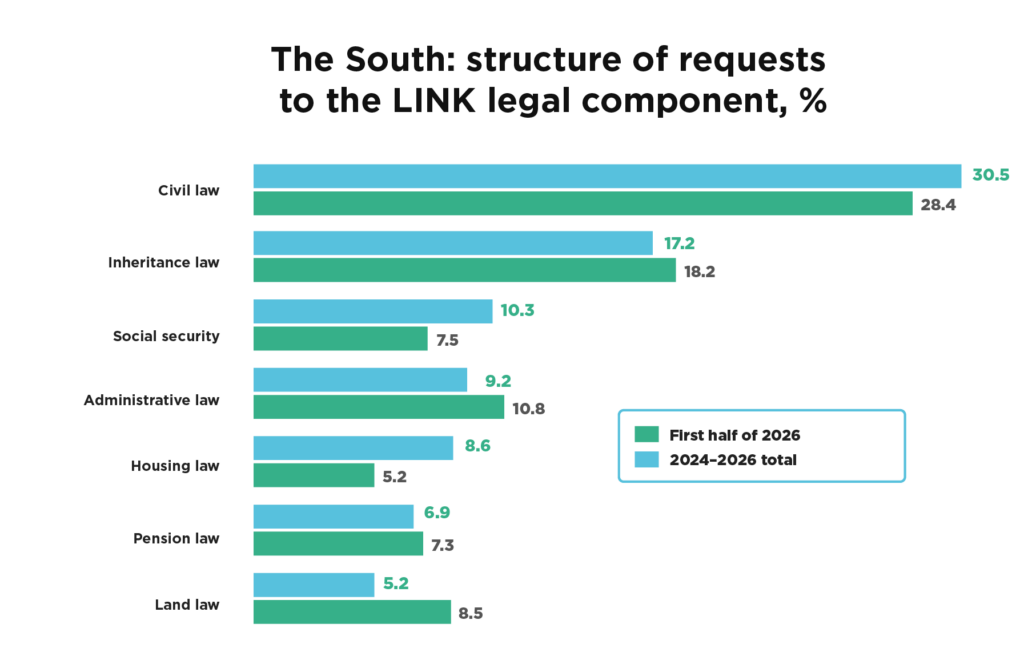
The third is a shift in the structure of branches of law. Civil law strengthened its position (30.5% against 28.4% for the whole period), while social security (10.3% against 7.5%) and housing law (8.6% against 5.2%) grew noticeably. Land law, by contrast, dropped by almost half — 5.2% against 8.5%. The growth in housing and social matters corresponds to the recovery stage: people are moving from the question of whose property this is to the question of how to rebuild it and what to live on.
The demographic profile remains unchanged: 81.7% of requests came from women and 51.4% from people aged 60 and over. This is the same group as in previous periods — older women who stayed behind or were the first to return.
A new topic deserves separate mention. Nine requests in the first half of the year concern the submission of claims to the Register of Damage caused by the aggression of the Russian Federation against Ukraine. The wording in the database is uniform: correct identification of the claim category, compliance with submission requirements and proper substantiation of the damage caused, as necessary preconditions for subsequent international compensation mechanisms. A further 23 requests concern national compensation procedures, and 7 concern housing certificates and the eVidnovlennia (eRecovery) programme.
The LINK legal component of the Legal Development Network is not the only channel of legal aid in the South. Among the Network’s members, the southern direction is represented by the NGO Time to Gather Ukrainians from Mykolaiv, and its half-year figures are among the most dynamic.
In the first quarter the organisation assisted 156 beneficiaries in 381 cases; in the second, 449 beneficiaries in 931 cases. This is almost a threefold increase in the number of people and a 2.4-fold increase in the number of cases, with the main growth falling on in-person reception: 87 beneficiaries in the first quarter against 386 in the second. In parallel, the organisation held 18 legal awareness events and 15 social cohesion events reaching 198 people — the third-highest figure in the Network in this area, after the CF Right to Protection and the NGO Pravo from Khmilnyk, Vinnytsia Oblast.
The nature of the cases is also specific. The organisation cites a case in which a civilian was returned to the territory of Ukraine from the Russian Federation and, with the assistance of lawyers, obtained the status of a person unlawfully deprived of personal liberty as a result of the armed aggression.
The NGO STEP from Zaporizhzhia may also conditionally be counted as part of the southern direction — the largest organisation in the Network after the CF Right to Protection. Both organisations work in regions with an active front line, and both substantially increased their volumes in the second quarter: STEP from 410 to 532 beneficiaries.
The overall dynamics across the Network are uneven: six organisations recorded a decline in volumes in the second quarter, and these include both rear-area organisations (Vinnytsia, Bila Tserkva, Kamianets-Podilskyi) and front-line ones (Dnipropetrovsk Oblast). To explain these fluctuations solely by the security situation would be an oversimplification — more probable factors are project funding cycles and changes in team composition, which lie beyond the available data.
Despite the differences in scale, channels and audiences, data from all sources converge on one type of problem — the gap between the actual state of rights and their documentary confirmation.
Mariia’s story from Zaporizhzhia is about the impossibility of entering into the register a right registered before 2013, because the archive remained under occupation. The case of the CF Right to Protection is about the loss of access to a housing certificate because the termination of ownership of destroyed housing was registered prematurely, at a point when two normative acts define the moment of such termination differently. The case of the NGO Trykutnyk from Kolomyia is about the impossibility of confirming an insurance record for the purposes of retirement, because the original documents remained in occupied territory and the educational institution has been liquidated. The case of the NGO Podilskyi Human Rights Centre is about a notary’s refusal to issue a certificate of inheritance because of a discrepancy between the address of the house and that of the land plot on which it stands.
In the data of the LINK legal component, the same mechanism is recorded on a mass scale: a discrepancy between the surname in the state land act and in the passport, which requires a legal fact to be established through the courts; more than five changes of workplace since the 1980s with no preserved links to the employers; a missed deadline for accepting an inheritance after a brother’s death; a co-heir who lives in Russia and does not intend to return.
These are not isolated procedural failures. This is a systemic feature: wartime support mechanisms — compensation, certificates, payments, international registers — are built on the assumption that people’s rights are already correctly reflected in state registers. For a significant part of the population of de-occupied and front-line territories, that assumption does not hold.
Notes:
An asterisk beside a name indicates that the name has been changed to protect personal data. The story was provided by the NGO Strategies and Technologies of Effective Partnership in cooperation with the Danish Refugee Council (DRC) and with funding from the European Union under its civil protection and humanitarian aid programme.
The analysis was prepared on the basis of the quarterly reporting of 18 member organisations of the Legal Development Network for Q1 and Q2 2026, online chat statistics as of 12 August 2026, indicators of the service for Ukrainians abroad, and the register of requests of the legal component of the LINK mechanism (175 requests, January–June 2026).
The LINK local humanitarian response coordination mechanism is implemented by the NGO Legal Development Network in cooperation with the Czech humanitarian organisation People in Need, with funding from the UK Government.
P. S. In June 2024, the Legal Development Network (LDN) launched a crowdfunding campaign, Recovery of The South of Ukraine , as part of the crisis response program #StandWithUkraine.
You can Recovery of The South of Ukraine |
If you have notices an error on the web-site, please, highlight the text and press ctrl-enter.
Print and place the Network's poster on a notice board in your entrance hall
Become a volunteer and assist others in finding problem solutions
0 800 331 113
from 10:00 to 17:00, toll-free within UkraineAsk a question, and one of the Network's experts will provide an answer.
Chat hours: daily from 10:00 to 16:00.
Ask questions via LawLink Bot in any convenient way. LawLink Bot is a smart and digital legal assistant created by the Legal Development Network.

The Legal Development Network implements comprehensive projects aimed at strengthening human rights, developing capable communities, and building sustainable tools for access to legal aid. We work at the intersection of advocacy, legal education, and local coordination of humanitarian response.

Support free legal aid in Ukraine. Your donation helps people affected by the war defend their rights in court and beyond.