Share on social media
Share
Tweet
Publication date: March 2, 2026
Author: Yulia Bilyk, Communications Manager, Legal Development Network
Throughout 2025-2026, the Legal Development Network, with the support of the GlobalGiving charitable platform, is implementing the project “Development of Legal Services to Meet the Needs of Vulnerable Groups.” The project focuses on internally displaced persons. Often, after leaving their homes and finding themselves in new cities and villages, people face a number of problems that they are unable to solve on their own due to a lack of resources and psychological exhaustion. The Legal Unity public organization in Bila Tserkva is one of those that, in addition to providing free legal aid, provides IDPs with comprehensive social support. Read on to find out how this works and what effect it has.
“We Are Here”: How Social Support Began
There are about 15,500 officially registered internally displaced persons in Bila Tserkva, but the actual number is closer to 19,000. The city has a single facility that houses both the IDP Support Center, a structural unit of the city’s social protection department, and an advisory body, the Council on Internally Displaced Persons. The NGO Legal Unity is a member of the Council, with which it has a long history of cooperation. It was at the request of the Council’s representatives that the organization began providing legal assistance to visitors to the IDP Support Center.
“We were initially invited to an informal dialogue: could you help the Center hire a lawyer—right where people can get key assistance? We agreed — why not, if it’s relevant to people and there’s a demand for it,” says Head of the Legal Unity NGO Oleksandra Shcherbina.
The request for a lawyer at the Center coincided with the opportunity for financial support from GlobalGiving. This made it possible to combine legal support with social support: twice a week, Oleksandra Shcherbina, as a lawyer, held office hours at the Center, while her colleague, Yelyzaveta Holub, a specialist in the needs of IDPs, worked nearby. Her task was to help internally displaced persons navigate the system of social and legal services and, if necessary, coordinate people with partner organizations.
The numbers behind the people
Over the course of six months, the team held 51 shifts at the IDP Support Center. A total of 232 people received legal assistance. In addition to formal consultations, there were 127 cases of social support, each of which required an individual, thoughtful approach.
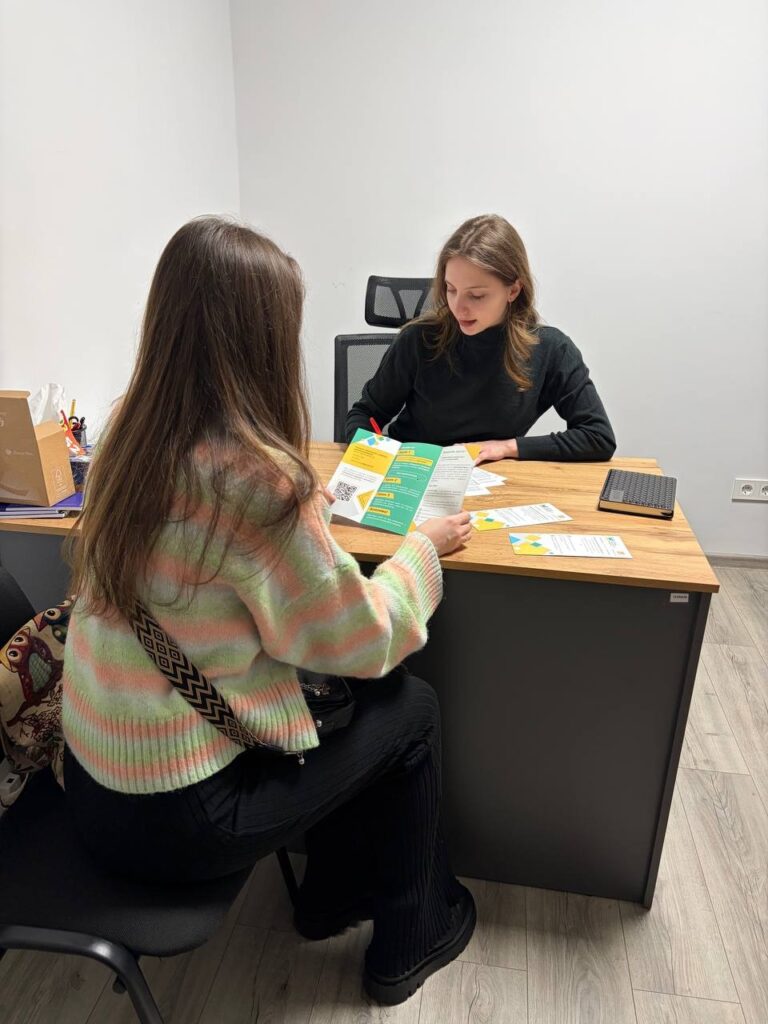
In terms of types of needs, requests for humanitarian and psychological support for children and adults, assistance in finding work, obtaining unemployment status, receiving vouchers for education, subsidies for housing rent, basic social assistance, and pension provision prevailed. At the same time, there were requests for compensation for destroyed/damaged property, assistance under the local support program, child support, family benefits, enrollment of children in schools and kindergartens, completion of medical declarations, and requests to the state archives to confirm place of employment and cases of domestic violence.
Every day, an average of 5 to 8 people come to the IDP Support Center to register their status. Requests come not only from city residents, but also from surrounding settlements. Several years ago, the NGO Legal Unity regularly visited villages in the Bilotserkivska community, leaving contact information and materials, which ensured a steady flow of requests in subsequent years.
An important communication tool is the Viber chat of the IDP Council chair, which has over 3,000 participants. Here, the team informs IDPs about the schedule of appointments, collects requests, and distributes important announcements.
How it works: from consultation to problem solving
Social support, as understood by Legal Unity, is not a one-time consultation, but rather a systematic process that does not end after the first appointment. In addition to explaining people’s rights and procedures to them, the team also actively refers them to the appropriate services — the Social Services Center, the Employment Center, the Pension Fund, the Bila Tserkva City Council — and always follows up on the results.
“People receive not only legal assistance — their problems, which may become apparent simply in the course of conversation, are also resolved. Each case of social support was individual: we had to work with both displaced persons who had been in the community for two or three years and those who had arrived only a few days ago. Some had disabilities, some were elderly, some were veterans. Each person received a completely individual approach,” emphasizes Oleksandra Shcherbina.
Finding their place: a family from Kharkiv
Each case of social support is a separate story about people’s fates, about challenges and how people accept them, about how they go from confusion to an orderly life in a new city. The case of a family from Kharkiv is illustrative. A mother with two school-age children came to Bila Tserkva; the father is in military service.
On the third day of her stay in the city, the woman came to the Support Center to register her IDP status, and upon learning of the presence of a lawyer, she sought advice. During the consultation, the lawyer reviewed the available documents on the destroyed housing and explained the procedure for applying for compensation. Legal Unity also arranged with a partner organization to provide the family with humanitarian aid: a food package, autumn and winter clothing for children, and hygiene products.
“During the conversation, the woman mentioned that her children in Kharkiv attended clubs: the boy was involved in mental arithmetic, and the girl was involved in drawing. On the same day, we contacted the Children’s Support Center, which provides comprehensive services for children from IDP families, military families, and large families, to find out if there were any places available for mental arithmetic and drawing. They replied: yes, there are, come on over. So the very next day, the children were able to attend classes,” says Oleksandra Shcherbina.
Later, the woman returned with a question about employment. A few months later, she came back to report the results: the children are attending classes, and she is doing an internship at one of the city’s enterprises.
“It was very valuable for us to hear feedback about our city, that it is beautiful, developed, and most importantly, that it is home to caring people. The client and her children are still adapting, but now it is much easier for them because they always know where to turn and that they can always count on support,” emphasizes Oleksandra Shcherbina.
Fighting for a pension: a man from Luhansk region
Another case is related to a common problem for internally displaced persons — applying for a pension without all the necessary documents. A 63-year-old displaced person from Luhansk region had been living in Bila Tserkva for about a year and a half, renting a room in a dormitory and experiencing financial difficulties due to problems with applying for a pension. The Pension Fund refused to recognize his work experience due to an unclear stamp and a corrected date in his work record book.
It was impossible to request a certificate from the company in Luhansk region where the man worked, as it had been destroyed. A request by Legal Unity to the State Archives of the Luhansk region was unsuccessful: some of the archives had been destroyed, and some were in uncontrolled territory. Thus, it was impossible to confirm his work experience without a court decision. Therefore, the organization’s lawyers prepared an administrative lawsuit.
At the same time, it turned out that, despite repeated appeals to the Pension Fund, the man had not been informed of his right to basic social assistance.
“When we informed the client about the possibility of receiving basic social assistance, he was skeptical and asked what kind of assistance had such a strange name. People were used to the fact that there used to be 40 different types of assistance, all with different names. We explained all the details, collected the necessary documents, and referred him to the Pension Fund. As a specialist, I was surprised that this person had repeatedly contacted the Pension Fund, was constantly refused, and was not even informed that it was possible to temporarily apply for at least some kind of assistance,” emphasizes Oleksandra Shcherbina.
In addition, the NGO Legal Unity referred the man to a partner humanitarian organization, from which he received food packages and winter clothing.
Although the lawsuit regarding the calculation of his pension is currently pending, the man already has a guaranteed basic income and reliable legal support in resolving the dispute with the Pension Fund.
“Even before the court’s decision, we were able to stabilize the man’s financial situation and thereby restore his faith in people and in the real possibility of defending his rights. He said, ‘At least I know that I am not alone and that I have a chance to get a decision in my favor,” notes Oleksandra Shcherbina.
Beyond consultations: roadmap, research, strategy
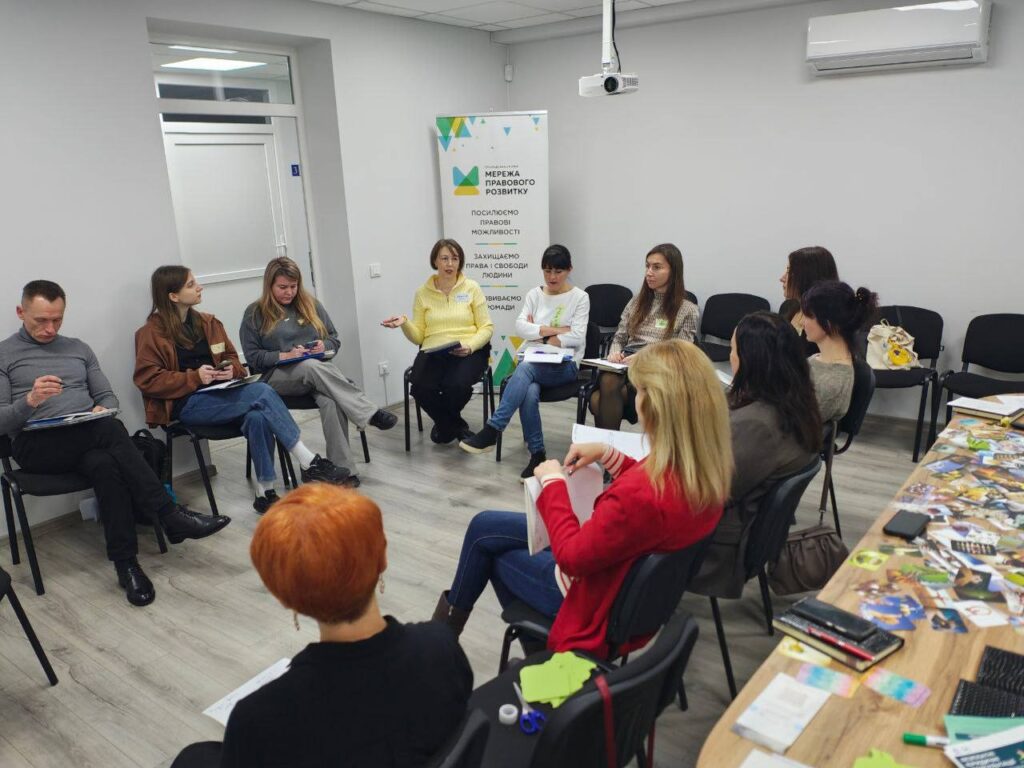
The NGO Legal Unity sees its role not only in providing individual social support to internally displaced persons, but also in developing local policies. In particular, the team developed a Roadmap for IDPs in the Bila Tserkva community. The organization involved 12 structures, services, and visitors to the IDP Support Center in the preparation of the document. The latter assessed the comprehensiveness and accessibility of the information presented.
“I repeatedly asked our IDP clients: please take a look at our work and tell us: is everything clear to you, is there enough information? People responded with great enthusiasm. They were happy to be involved in the process of creating something small but quite important,” says Oleksandra Shcherbina.
The organization also conducted a sociological study entitled “Solving the Housing Problems of IDPs,” surveying 264 participants online. The results of the study identified four key problems in the Bila Tserkva community: lack of affordable long-term housing, information barriers, misunderstanding of procedures, and a significant financial burden on IDPs.
“These problems limit the fair access of internally displaced persons to existing housing programs. For example, the initial contribution to participate in the state program “yeOselya” is a large sum of money, which, of course, most displaced persons do not have. Therefore, when we discussed the results of the study, all participants agreed that we have serious advocacy work ahead of us to make changes to the local IDP support program in the community. In particular, we want to ensure that newly arrived IDPs can stay in the city council’s communal hotel free of charge for up to three weeks, rather than just three days as is currently the case,” notes Oleksandra Shcherbina.
A separate important achievement was the joint vision for 2026, formed as a result of strategic sessions between the Legal Unity NGO and the IDP Council. Social support for displaced persons has been established as a strategic and ongoing priority.
Current situation and prospects
In the fifth year of full-scale war, the humanitarian situation is worsening. People from communities close to the front line are forced to move to safer places, and host communities must find resources to meet the needs of displaced persons — both those who arrived in previous years and new arrivals. According to Oleksandra Shcherbina, every second person with IDP status in Bila Tserkva applies for humanitarian aid — food, heaters, blankets, clothing.
In these conditions, social support, implemented through a partnership with the Legal Development Network and financial support from GlobalGiving, provides people not only with information about their rights, but also with practical assistance. Legal Unity considers this area of work to be an integral part of its institutional activities.
“Every day we see how exhausted and disoriented people are. They come to us because they hear about how we have helped someone else. And we continue to do everything we can to let people know that support is available,” emphasizes Oleksandra Shcherbina.
The material was created by the Legal Development Network with the support of the international charitable platform GlobalGiving. The content of this publication is the sole responsibility of the Legal Development Network.
|
Отримайте поглиблену консультацію через чатбот LawLink
|
P. S. In June 2024, the Legal Development Network (LDN) launched a crowdfunding campaign, Recovery of The South of Ukraine , as part of the crisis response program #StandWithUkraine.
You can Recovery of The South of Ukraine |
If you have notices an error on the web-site, please, highlight the text and press ctrl-enter.
Print and place the Network's poster on a notice board in your entrance hall
Become a volunteer and assist others in finding problem solutions
Ask question and one of the LDN's lawyers
will answer it.
Chat's schedule: from 10 to 16
every day
Ask questions via LawLink Bot in any convenient way. LawLink Bot is a smart and digital legal assistant created by the Legal Development Network.

The Legal Development Network implements comprehensive projects aimed at strengthening human rights, developing capable communities, and building sustainable tools for access to legal aid. We work at the intersection of advocacy, legal education, and local coordination of humanitarian response.