Share on social media
Share
Tweet
Publication date: June 29, 2026
Author: Halyna Kolesnyk, Director of Strategic Communications at the Legal Development Network (LDN), Communications Manager of the “Open Community, Transparent Investments” project
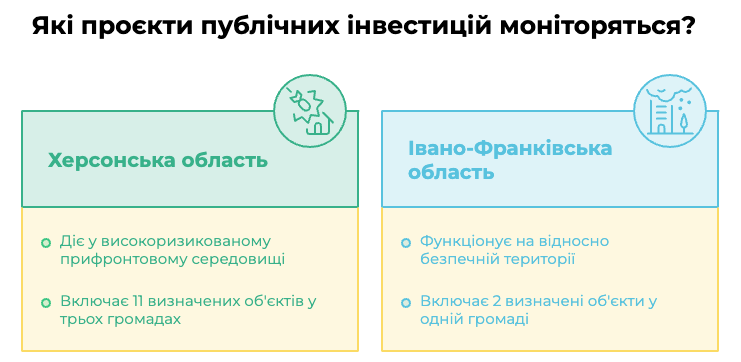
Since April 2026, the Legal Development Network has been implementing the “Open Community, Transparent Investments” project in partnership with the Institute for Economic Research and Policy Consulting, with the support of the European Union. Its goal is to track how the public investment projects (PIP) reform is being implemented in communities across different regions of Ukraine: in the frontline Kherson Oblast and the relatively safe Ivano-Frankivsk Oblast. Experts have already identified 13 objects in the Dariivska, Velykoaleksandrivska, and Vysokopilska communities of Kherson Oblast and the Dubovets community of Ivano-Frankivsk Oblast, and have begun collecting data from open sources. Two more public investment projects are currently being identified.
Andrii Alexandrovych and Anton Stasik are engaged experts of the Legal Development Network in investment project monitoring. They already have experience with similar work through a reconstruction monitoring project in Kherson Oblast and are now applying that knowledge at a significantly larger scale. In this interview, they discuss methodology, challenges, and the human-centered approach to monitoring public investments.
Залучені експерти Мережі правового розвитку з моніторингу інвестиційних проєктів
LDN: You already have experience monitoring reconstruction from last year. How does this year’s project differ from what you did before?
Andrii Alexandrovych: In the previous project we had five objects, mostly individual construction in Kherson Oblast. At that time, the public investment projects reform had not yet been fully implemented. Our main tool was Prozorro, and we tried to track whether a project was actually being executed rather than just existing on paper.
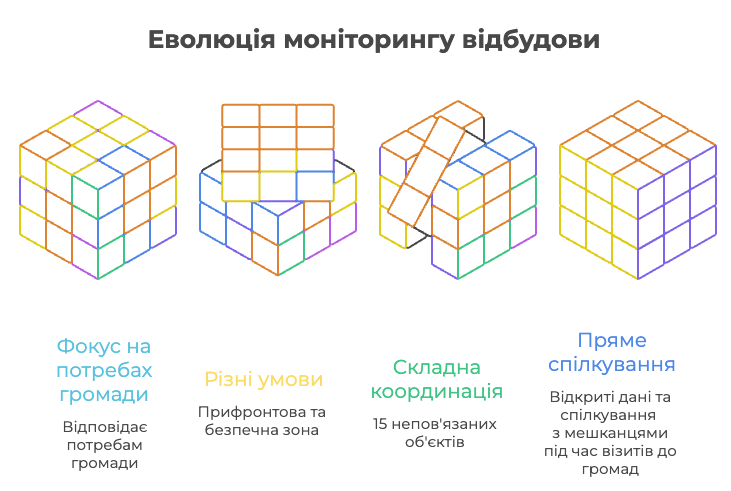
This year everything is different. First, we moved away from the logic of construction for construction’s sake and shifted to the question: does the project meet the community’s needs? A public investment project is not just a capital repair — it is an object that should bring social and economic benefit to people. Second, Ivano-Frankivsk Oblast was added to Kherson Oblast, which gives us a unique opportunity to see how the PIP reform works under fundamentally different conditions: a frontline zone and a relatively safe region. And third, we now have 15 objects instead of five, and they are not connected to each other — this is a significantly more complex coordination challenge.
Anton Stasik: I would add that last year we understood very clearly that open data does not give the full picture. We saw documents in Prozorro, acts of completed work, additional agreements on deadline extensions — and the first reaction was: someone is delaying, someone is underperforming. But when we went out to the field and spoke with the community head, it turned out to be something completely different. He told us how he personally confiscated the contractor’s trailers to force them either to return the money or complete the work. That is not visible from open sources. So in this year’s project, we built in this approach from the start: first open data, then — without exception — direct communication.
LDN: You mentioned that last year it was difficult to understand who to contact — requests were going around in circles between the ministry and the military administration. Is it easier this year?
Andrii Alexandrovych: The situation has become somewhat clearer in terms of the regulatory framework, but in practice the challenge remains — it has just changed its form. Before, we did not know who was responsible in this chain at all. Now we know that behind one object there are five or six different people: the head of the institution, the department of education or another sector, a technical specialist, a lawyer, the person responsible for procurement, the person entering data into DREAM. And each one is responsible only for their own block.
I even compiled a “contact matrix” for myself — a kind of scheme where for each object I record who is responsible for each block of questions. Because if you have 15 objects and five or six contacts per object — without structure you simply get lost.
Anton Stasik: This actually reflects the reform itself. It is built to distribute responsibility across different levels and functions. But for an external observer — whether a monitoring organization or an ordinary resident — this distributed structure can look like a lack of transparency. So our approach is to build trusted informal contacts, and only through them get a real understanding of what is happening.
LDN: Tell us more about the challenges you have already encountered in this project.
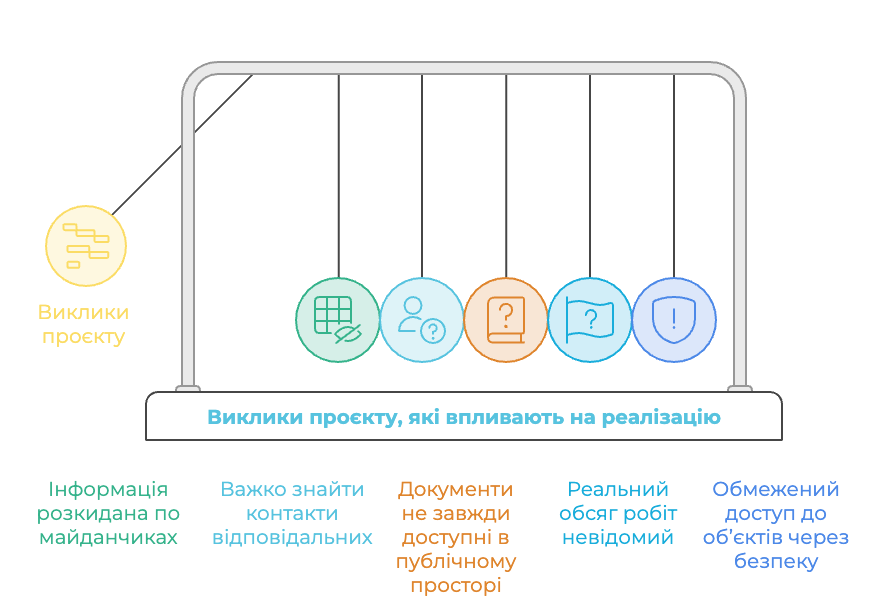
Andrii Alexandrovych: I would highlight five. The first — it is difficult to trace the full path of a project from idea to implementation. The information exists, but it is scattered across DREAM, Prozorro, community websites, and council decisions — which are not always published in a convenient format. The second — contacts of responsible persons. Formally there are general phone numbers and email addresses, but in practice you need the personal mobile number of the specific person managing a specific block. Finding that person is a separate quest.
The third challenge — different levels of document availability. Some communities publish their strategies, programs, and council decisions well. In others — even medium-term investment plans or unified project portfolios are nearly impossible to find. Yet it is critically important for us to understand whether a specific PIP corresponds to the community’s development strategy. The fourth — the actual condition of objects. DREAM shows the project map, Prozorro shows the procurement. But the real scope of completed work, problems with contractors, delays — you only find out through direct communication. And the fifth — security. In Kherson Oblast, some objects are located in communities with restricted access. I have already heard from responsible persons that it is currently dangerous in one community or another. This affects both project implementation and our ability to monitor.
Anton Stasik: I would like to add one more point — the quality of the strategies themselves. Local self-government bodies were at some point required to create recovery strategies. And it will be very interesting to see how well these documents reflect the actual state of affairs, rather than simply being completed as a formality. Because a strategy is not a piece of paper for a checkbox — it is a document that should reflect the community’s genuine priorities. We will compare: to what extent do the investment projects actually correspond to these strategies.
.
LDN: You have already begun calling communities. What have you been able to learn at this stage?
Andrii Alexandrovych: The first and very important thing: all our objects are not abstract construction. They are shelters in schools and kindergartens, catering facilities, civil protection structures, one ambulatory clinic. That is, objects that directly affect people’s basic access to education, healthcare, and safety. This already sets a completely different emotional and analytical focus.
What strikes me is that even basic questions — such as “is your project included in the unified project portfolio” or “does it correspond to the medium-term investment plan” — sometimes cannot be answered by people in the communities. Not because they are poor specialists, but because this reform is relatively new and not everyone has yet worked through all its requirements. And this is exactly where there is space for our work.
Anton Stasik: And this essentially illustrates our methodology. We are not looking for corruption and not trying to find that a brick cost 100 hryvnias but was purchased for 110. Our format is to help communities work through the challenges that arise during implementation of the new regulatory framework. Because behind specific positions, there are real people. They may be afraid of something, may not have understood something, may have questions. The goal is not to point to incompetence, but to help — so that going forward, the community can independently respond to such challenges.
LDN: What are you taking from the previous project’s experience into this one?
Andrii Alexandrovych: The methodology and general approaches. Specifically — a four-block algorithm. The first — open sources: DREAM, Prozorro, community websites, council decisions. The second — desk research of documentation. The third — official information requests, though these do not always yield relevant responses. The fourth and most effective — informal communication: with community leaders, residents, responsible persons. The field visit was what gave us the most in the previous project. Only in this way can you hear different perspectives, look at the situation from various angles, and get a comprehensive picture.
Anton Stasik: Last year we understood that this is a complex problem that cannot be solved by publishing articles about someone doing something wrong. Systematic advocacy work is needed. And this is precisely what the PIP reform is — it began back in 2015, when the World Bank initiated the relevant movement. The war simply accelerated the process: destruction, the need for funds, the need to report to donors. DREAM became active precisely because of this. So our work is part of this broader reform — accompaniment, not control.
Incidentally, on June 22 the Cabinet of Ministers of Ukraine approved the medium-term plan for priority public investments for 2027–2029: a total volume of 279 billion hryvnias, 18 priority sectors, 44 subsectors, 67 directions. So planning continues. And in this context, our project is an opportunity to see how this system actually functions at the level of specific communities.
LDN: How do you plan to use the monitoring results? How will you be able to help communities address the gaps you identify?
Anton Stasik: The project includes planned public events where we will be able to invite representatives of the communities we work with. If we see something specific — an information gap, a missing document, logic for selecting projects that is unclear to residents — we will be able to say so openly and constructively. But even more importantly, we can share this directly with the community during the process of our work, and explain how it can be corrected.
I predict that after the first field visit — when we explain who we are, what we are doing, and what our goal is — the first requests will come from the communities themselves: to clarify a question, to help with a specific aspect of the reform. Requests from communities to experts are currently framed exactly this way: “there is a need, please help with your expertise.” And I think we will be able to respond.
Andrii Alexandrovych: I want to repeat: transparency is not only about control — it is also about protecting the community itself. When decisions are well-justified and documents are accessible, it is easier for the community to communicate with donors, the state, and other oversight bodies. If a shelter is being built — it should be clear: for whom, what problem it solves, why this particular object was chosen, with what funds, and who is responsible for the result. These things should be accessible to ordinary residents. That, for me, is the true goal of this project.
This material was created within the “Open Community, Transparent Investments” project, which is part of the “Public Investment Control” project with financial support from the European Union.
The Legal Development Network is responsible for the content of this publication; its content does not necessarily reflect the position of the EU. The “Public Investment Control” project is implemented by the Centre for Economic Strategy, the Institute for Economic Research and Policy Consulting, and the NGO “Technologies of Progress.”
P. S. In June 2024, the Legal Development Network (LDN) launched a crowdfunding campaign, Recovery of The South of Ukraine , as part of the crisis response program #StandWithUkraine.
You can Recovery of The South of Ukraine |
If you have notices an error on the web-site, please, highlight the text and press ctrl-enter.
Print and place the Network's poster on a notice board in your entrance hall
Become a volunteer and assist others in finding problem solutions
0 800 331 113
from 10:00 to 17:00, toll-free within UkraineAsk a question, and one of the Network's experts will provide an answer.
Chat hours: daily from 10:00 to 16:00.
Ask questions via LawLink Bot in any convenient way. LawLink Bot is a smart and digital legal assistant created by the Legal Development Network.

The Legal Development Network implements comprehensive projects aimed at strengthening human rights, developing capable communities, and building sustainable tools for access to legal aid. We work at the intersection of advocacy, legal education, and local coordination of humanitarian response.

Support free legal aid in Ukraine. Your donation helps people affected by the war defend their rights in court and beyond.