Share on social media
Share
Tweet
Publication date: July 31, 2026
Author: Yuliia Bilyk, Communications Manager, Legal Development Network
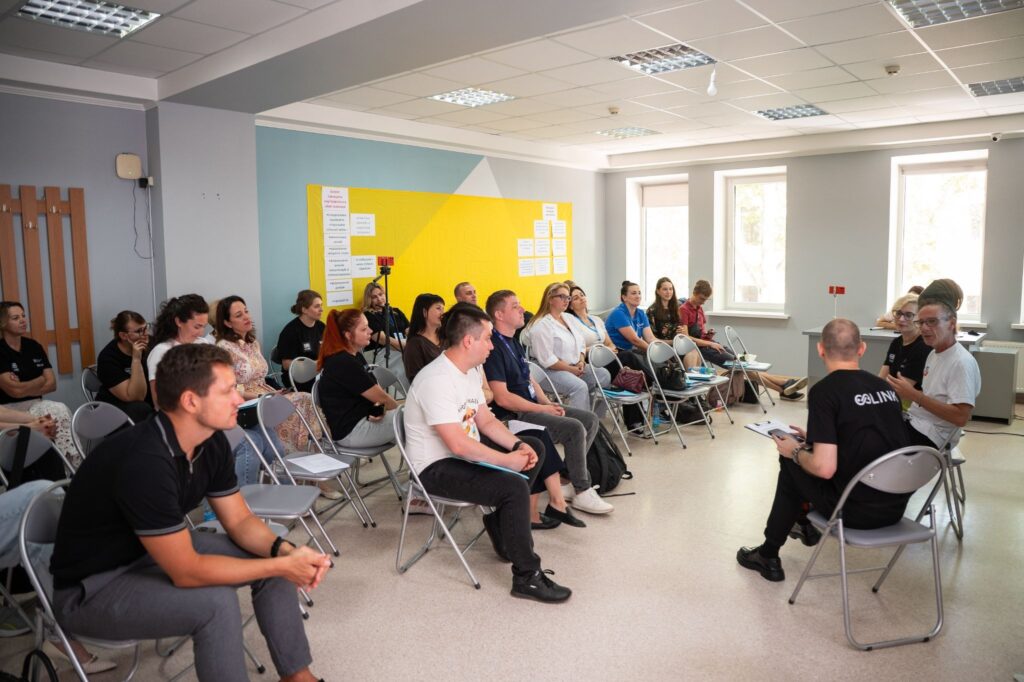
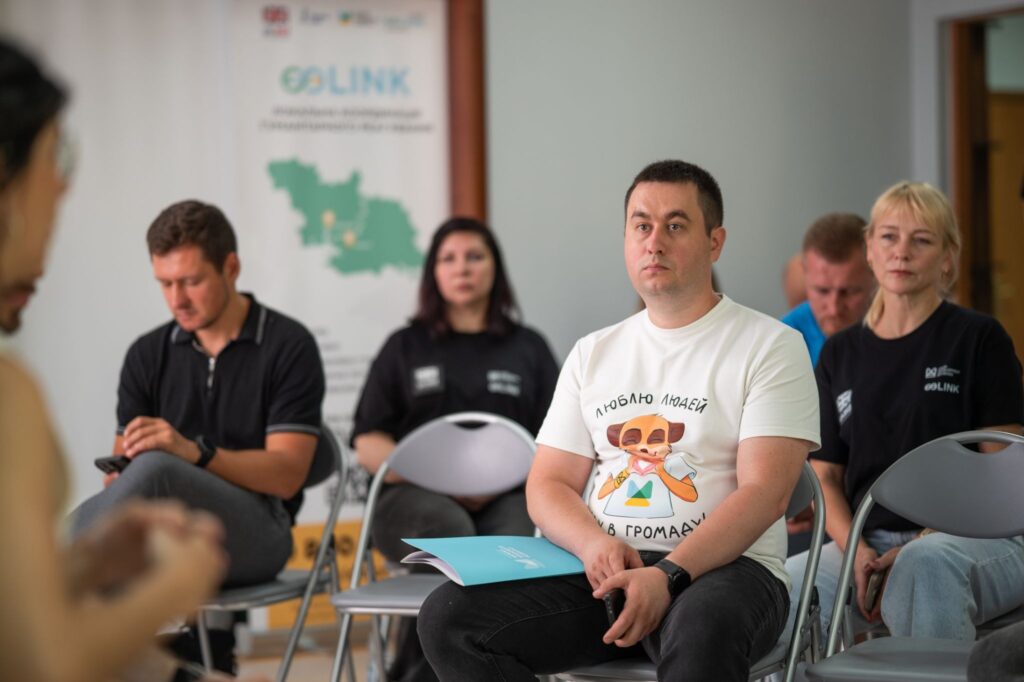
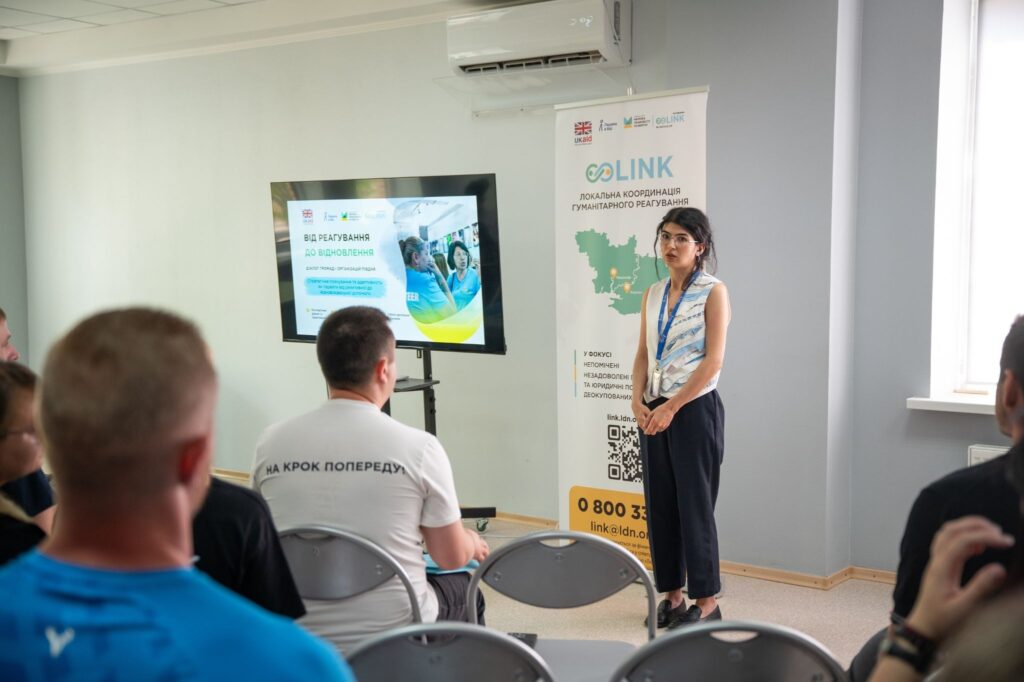
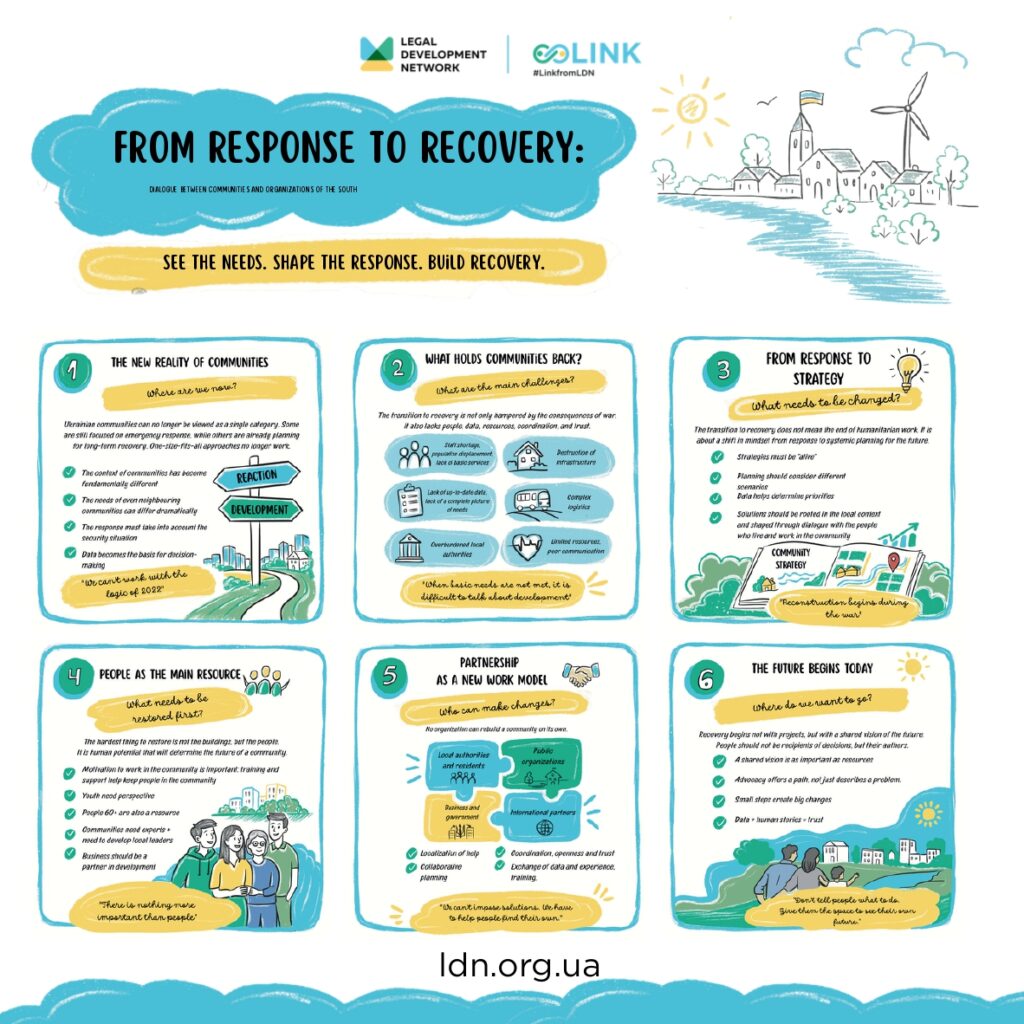
Five years into the full-scale war and in the fourth year of the LINK local humanitarian coordination mechanism, strategic approaches to organizing assistance for war-affected communities have become essential. As we collect information on humanitarian needs and communicate with partners, one thing has become clear: reactive action alone is no longer sufficient. Despite the persistently challenging security situation, most de-occupied communities are now pursuing recovery. During the expert dialogue “Strategic Planning and Adaptability: How to Shift from Reactive to Recovery-Oriented Assistance,” held in Mykolaiv, participants discussed how humanitarian actors can help communities make recovery not only successful but also achievable.
Since 2023, the Legal Development Network, in partnership with the Czech humanitarian organization People in Need and with financial support from the UK Government, has been implementing the LINK mechanism. LINK enables humanitarian organizations to access verified information on overlooked humanitarian needs in de-occupied communities across southern Ukraine while helping those communities receive the assistance they need more quickly.
As of the end of July 2026, the LINK team had collected more than 10,000 humanitarian needs from de-occupied communities in the Mykolaiv and Kherson regions. Nearly half of these needs have already been addressed through the resources of humanitarian organizations and foundations partnering with LINK, using information available through the LINK platform.
Among the 25 communities cooperating with LINK are those located directly along the front line and subjected to daily shelling, as well as communities living in relatively safer conditions. The platform also supports communities whose territories remain under occupation and whose authorities continue to sustain governance and assist displaced residents from relocation sites. Such dramatically different contexts — even between neighboring communities — fundamentally shape the way humanitarian assistance must be organized.
“Some de-occupied communities come under shelling every hour and have absolutely no opportunity to think about recovery. Others have already begun attracting additional investment and rebuilding. Every community has its own unique context, and in our work we strive to take each of those contexts into account,” says Oleksii Tertyshnyi, Programme Director of the Legal Development Network.
According to Oleksii Tertyshnyi, the Legal Development Network’s primary objective — and one for which it continues to seek partners’ support — is to combine humanitarian response with the principles of community recovery and long-term development.
“Alongside collecting and verifying humanitarian needs, we support communities in developing and implementing their recovery and development strategies. Three communities — Mishkovo-Pohorilove and Shevchenkove in Mykolaiv Oblast, and Bilozerska in Kherson Oblast — already have completed strategic documents and are implementing them step by step. This year, two additional communities — the Kalynivska and Velykooleksandrivska communities in Kherson Oblast — are receiving our support in preparing their own strategies. The question of how we continue working with these and other communities remains open, and it is one that can only be answered collectively by all actors involved in humanitarian response,” Tertyshnyi emphasizes.
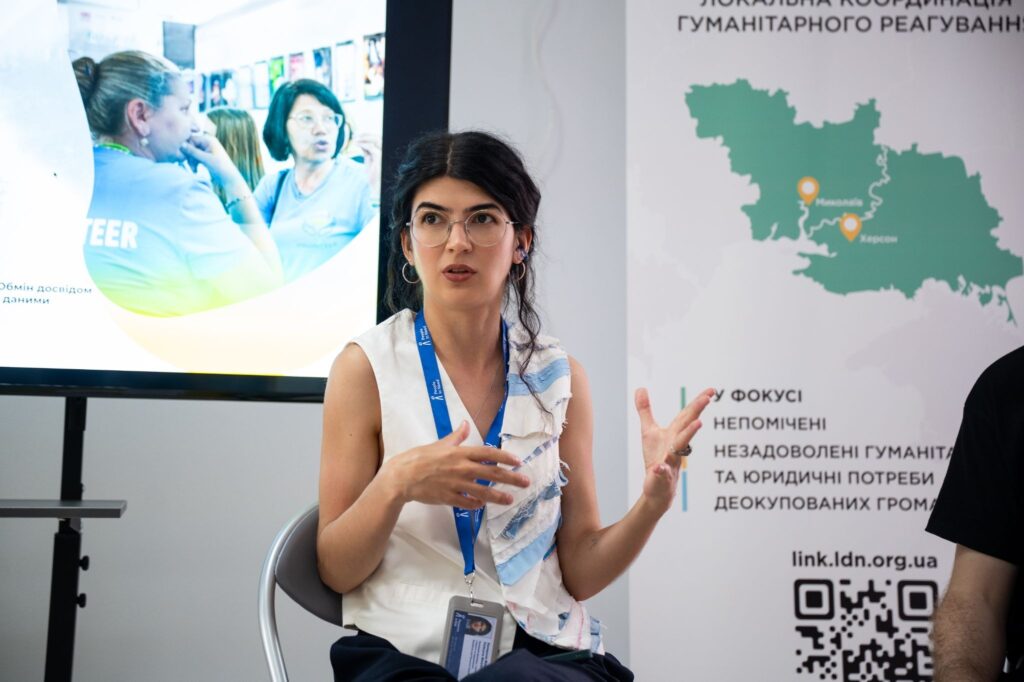
Kateryna Matsiienko, Resilience and Recovery Coordinator at the Czech humanitarian organization People in Need, explains that, in practice, there is no such thing as a transition from humanitarian response to recovery because the two processes take place simultaneously.
“We cannot say that we will focus only on meeting humanitarian needs and rapid response while postponing recovery and development projects. At the same time, we cannot ignore the daily challenges that communities — and all of us as citizens of this country — are facing. Nor can we decide to concentrate solely on development projects while neglecting the urgent basic needs of Ukraine’s population,” says Kateryna Matsiienko.
Matsiienko stresses that no community development strategy should be limited to a vision of a peaceful future alone. It must also anticipate how the community will respond if circumstances suddenly change.
“One of the requirements we incorporate into community development strategies is a mandatory emergency response plan. Even where the current situation is relatively stable, the strategy must recognize that conditions can change at any moment, and the community should already know how it will respond under each possible scenario.”
Another major challenge facing humanitarian actors is the reduction in available funding. This reality has also been incorporated into People in Need’s updated five-year strategy.
“We need to establish clear criteria and ensure that assistance is provided where it is not already being delivered by other humanitarian organizations, in order to avoid duplication. We identify the most vulnerable population groups with the greatest need for support and focus our work on rural communities. This is what shapes the context of our work and became the starting point of the analysis during the development of our new strategy,” Kateryna Matsiienko concludes.
In the humanitarian sector of 2026, local self-government authorities (LSGAs) and local civil society organizations (CSOs) are playing an increasingly central role. Today, the greatest impact is achieved by initiatives that have invested in building strong local partnerships over previous years.
According to Kateryna Matsiienko, localization and support for local actors have always been guiding principles of People in Need’s humanitarian policies.
“We work closely with our local partner organizations to engage and strengthen local actors in delivering services and implementing projects, because they possess the deepest understanding of the local context and have already established trusted relationships within their communities,” Kateryna Matsiienko explains.
People in Need follows a regional approach, maintaining regional offices that cooperate directly with local self-government authorities. At the national level, the organization coordinates its activities with sectoral working groups and government ministries while operating a dedicated advocacy department. At the same time, its approach recognizes that every region — and every individual community — has its own unique circumstances that require tailored solutions.
“Whenever we implement a project, we seek to establish close cooperation with local authorities so that our work is coordinated with local stakeholders. Platforms such as LINK are designed precisely to connect different actors — bringing together large international humanitarian organizations, local governments, volunteer groups, and small civil society organizations,” Kateryna Matsiienko emphasizes.
LINK’s local teams regularly visit partner communities while maintaining continuous communication with local self-government authorities and community activists by phone. At the same time, partner organizations using the LINK platform and reserving community requests deliver humanitarian assistance directly to the affected settlements. These frontline responders witness local realities firsthand and have an unparalleled understanding of what communities genuinely need.
Humanitarian logistics is the core specialization of the charitable organization Koridor UA, which has worked closely with LINK over the past several years. Adéla Pafková, Recovery Project Coordinator at Koridor UA, recalls that communities’ requests during the first year of the full-scale invasion differed significantly from those received today. However, over the past three years, the list of priority needs has remained remarkably consistent.
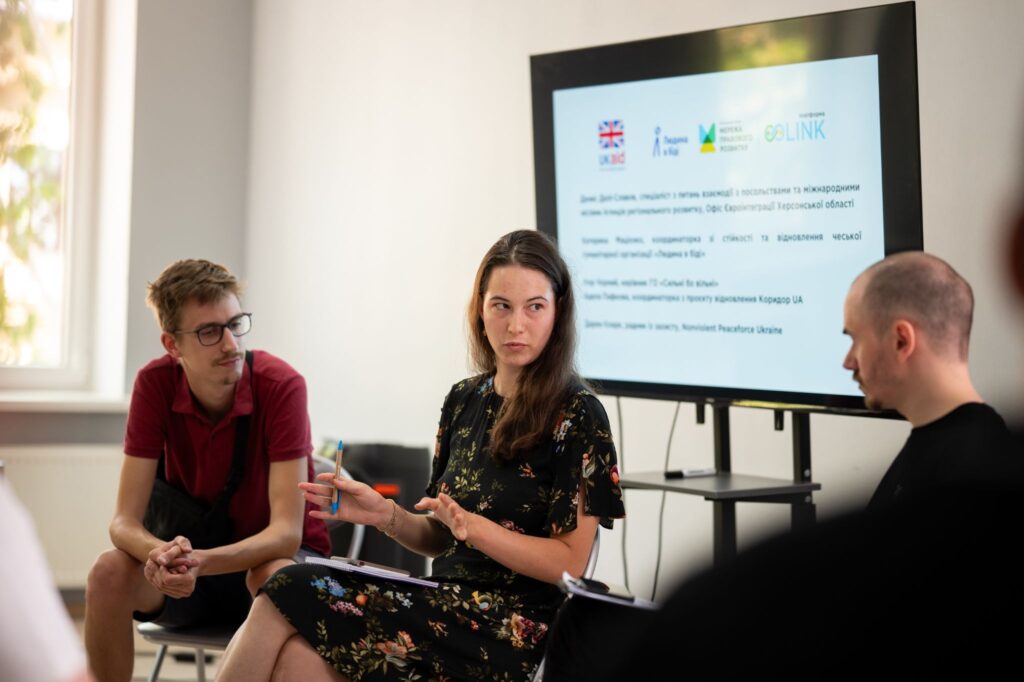
“Food, water, and clothing were among the primary types of assistance we delivered in 2022. However, over the past few years, these items have become much less important for our beneficiaries. Instead, hygiene products, medical supplies, electronic equipment, and similar items continue to be in demand — especially following the suspension of USAID (the United States Agency for International Development) activities,” says Adéla Pafková.
According to Pafková, the most significant trend today is that demand consistently exceeds available supply. Koridor UA’s analysis shows that assistance such as hygiene products remains permanently needed, with requests showing no sign of declining. Last spring, the organization launched fundraising campaigns for solar power plants and generators, both of which were in exceptionally high demand. Today, the Czech team is beginning projects aimed at equipping communities with solar energy systems.
Adéla Pafková notes that Koridor UA’s cooperation with the LINK platform has significantly increased both the speed and the scale of humanitarian assistance delivered to communities in southern Ukraine.
“Thanks to LINK, identifying recipients for the humanitarian aid we can provide now takes one day instead of a week or even a month. We are able to reach communities requiring assistance much more quickly, including places that, without LINK, we might never have established contact with,” Adéla Pafková emphasizes.
According to Pafková, while in 2023 Koridor UA completed no more than 10 aid transfer agreements per month, today it regularly finalizes at least 20. She also attributes this increase to the impact of LINK.
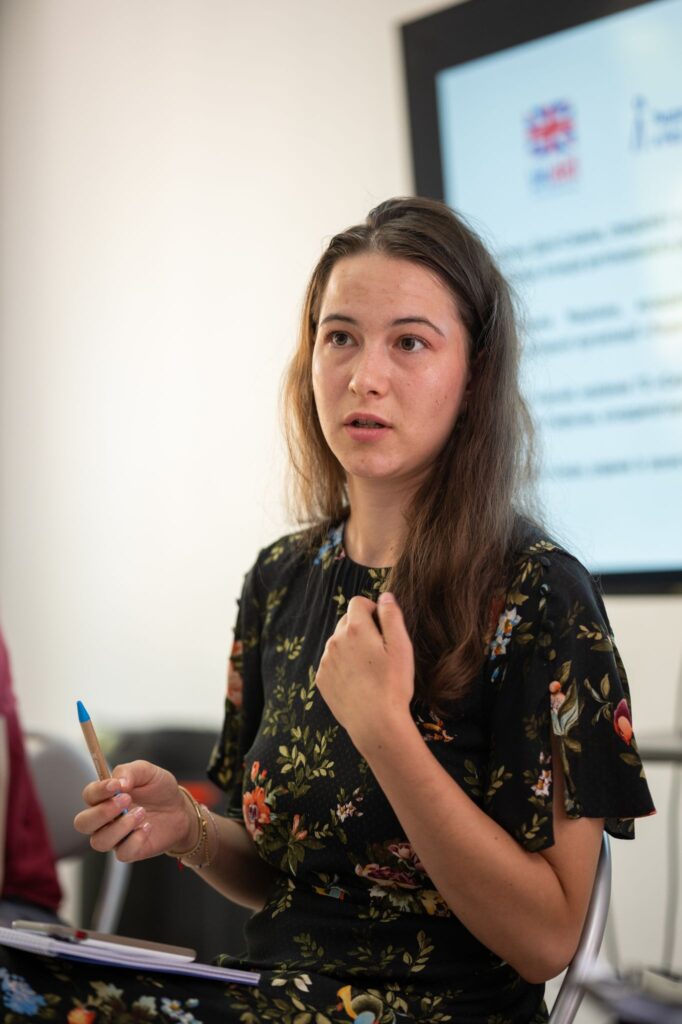
“The LINK team communicates directly with people rather than only with local administrations. That gives us greater confidence that the requests we receive truly reflect unmet needs and that no one has been overlooked. It also reassures us that the assistance will reach its intended recipients. If we wanted to achieve the same results without LINK, we would have had to invent LINK ourselves.”
Another partner of the Legal Development Network is Nonviolent Peaceforce Ukraine, an organization dedicated to the protection of civilians affected by armed conflict. Speaking about the advocacy dimension of supporting de-occupied communities, Darren Clark, Protection Adviser at Nonviolent Peaceforce Ukraine, highlighted the risks associated with a purely formal approach to setting advocacy priorities.
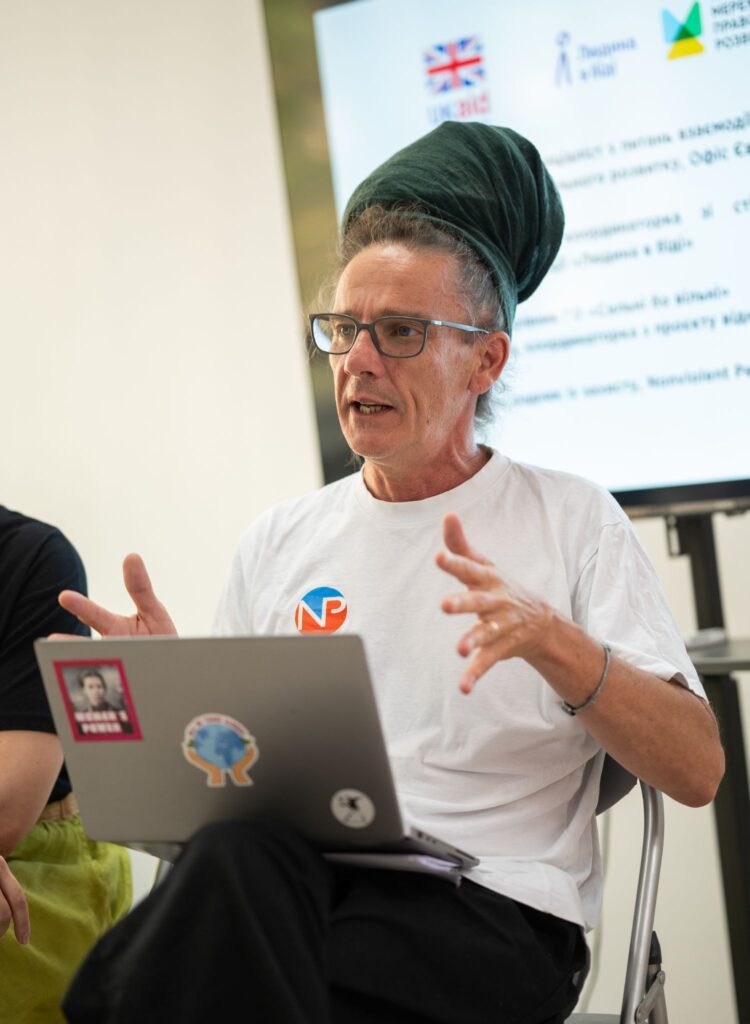
“Advocacy is not only about identifying problems — it is also about defining concrete steps to solve them. One of the persistent challenges in advocacy is that final recommendations are often drafted by a few individuals late at night, rushing to submit reports to donors. As a result, those recommendations do not always reflect the voices and ideas of the very people they are intended to support.”
Darren Clark introduced a practical tool that Nonviolent Peaceforce uses to promote nonviolent approaches to social change. The “Three Horizons” exercise is a structured process that helps participants, first, analyze their current reality; second, reflect on where they want to be in the future; and third, develop their own vision of that future.
“When responding to emergencies, we are often standing so close to the mountain — the problem — that we cannot see its summit, which represents the solution. People frequently understand the challenges they face but struggle to imagine what the solution could look like. When you are forced to respond minute by minute every single day, it becomes extremely difficult to step back and see the bigger picture,” Darren Clark explains.
Clark believes that community members themselves know better than anyone else what is best for their future. Therefore, presenting them with ready-made action plans instead of involving them in shaping solutions is a mistake.
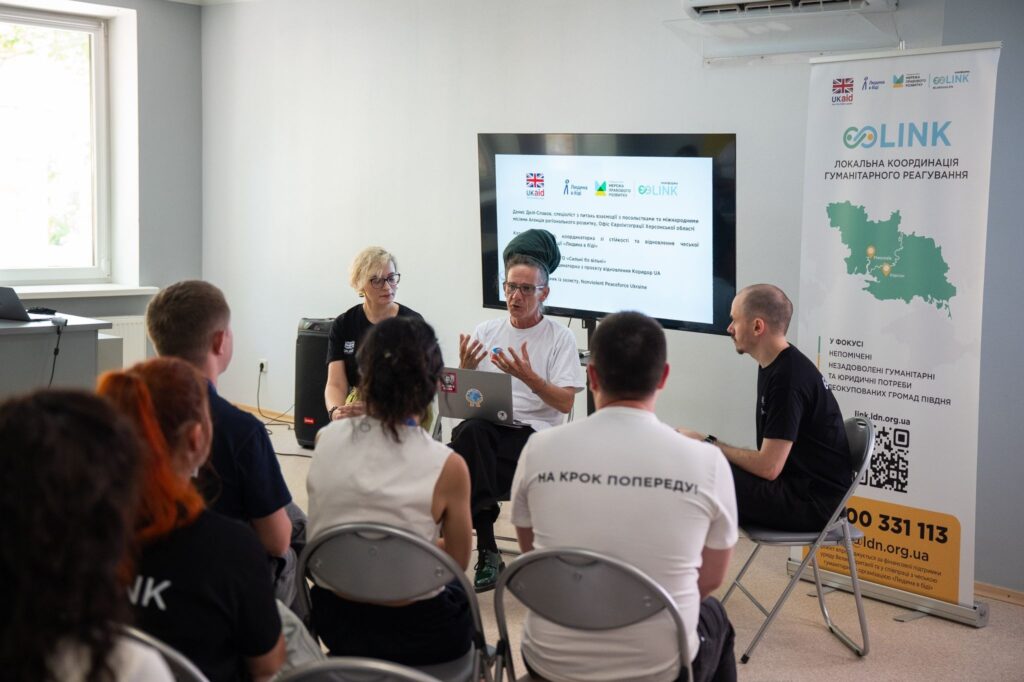
“Advocacy on behalf of communities requires the participation of everyone involved — above all, ordinary people. Those living under constant stress need both the time and the space to reflect on where they want to go and what steps they need to take to get there,” Darren Clark emphasizes.
Drawing on his many years of experience working in post-conflict societies around the world, Clark pointed out that Ukrainians are currently united by a common struggle against a common enemy. Ironically, however, this shared sense of unity may become most vulnerable once the fighting ends.
“Today, Ukrainians are united by the struggle against a common enemy. Yet when the war is over and that unifying purpose disappears, there is a significant risk that society will become divided. In every country where I have worked after armed conflicts, I have witnessed deep divisions emerging between different groups of people.”
To illustrate this point, Clark asked participants to spend 30 seconds imagining that they had a blank sheet of paper on which to draw the future Ukraine they hoped to see.
He then asked how many had imagined children playing together.
It turned out to be a remarkably common image. Participants envisioned Ukrainian children growing up with a fundamentally different life experience from their own — a country where mothers no longer fear giving birth to sons because of war, where children simply go to school and play together.
“I don’t think any of you imagined children arguing with one another and saying, ‘My father fought for our country.’ Those who served, those who left the country, those who returned, those who lost loved ones or their homes — everyone has their own truth about this war, and everyone has experienced loss,” Darren Clark says.
Clark stressed that the greatest challenge of post-war recovery is not merely rebuilding damaged infrastructure. It is rebuilding society itself and ensuring that veterans, internally displaced people, residents of formerly occupied territories, and everyone else affected by the war are able to understand one another and live together again.
“If we want to build a society that respects human rights, where children return safely to school, where veterans come home and receive mental health support, and where homes are rebuilt, we must find common ground and begin working now to overcome the divisions that already exist within society.”
The expert dialogue enabled partners to hear one another, exchange experiences, learn from different approaches, and coordinate future action. The shared objective is not only to respond to urgent humanitarian needs today but also to lay the groundwork for Ukraine’s gradual post-war recovery.
The insights generated during the discussion, together with other analytical findings, will form the basis of a joint position paper outlining the decisions and policy measures required to strengthen effective support for affected communities.
This material was prepared by the Legal Development Network in cooperation with the Czech humanitarian organization People in Need and with financial support from the Government of the United Kingdom.
The conclusions, interpretations, and other information presented in this publication reflect solely the views of the authors and do not necessarily represent the positions of the donors or the project’s partner organizations.
P. S. In June 2024, the Legal Development Network (LDN) launched a crowdfunding campaign, Recovery of The South of Ukraine , as part of the crisis response program #StandWithUkraine.
You can Recovery of The South of Ukraine |
If you have notices an error on the web-site, please, highlight the text and press ctrl-enter.
Print and place the Network's poster on a notice board in your entrance hall
Become a volunteer and assist others in finding problem solutions
Ask question and one of the LDN's lawyers
will answer it.
Chat's schedule: from 10 to 16
every day
Ask questions via LawLink Bot in any convenient way. LawLink Bot is a smart and digital legal assistant created by the Legal Development Network.

The Legal Development Network implements comprehensive projects aimed at strengthening human rights, developing capable communities, and building sustainable tools for access to legal aid. We work at the intersection of advocacy, legal education, and local coordination of humanitarian response.

We make legal aid accessible. We empower communities and help them develop. Support us in this work.