Share on social media
Share
Tweet
Publication date: August 28, 2026
Author: Yuliia Bilyk, Communications Manager at the Legal Development Network
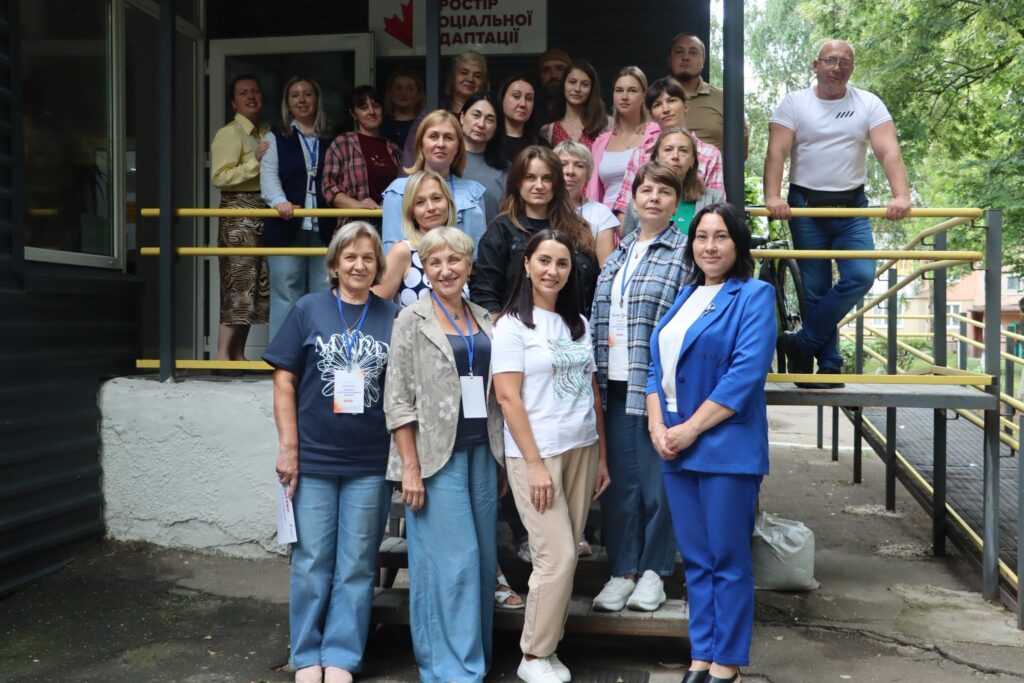
Ukrainian communities are diverse, but they have more in common than they have differences. Practices that have proven successful in some communities can be applied in others, even if thousands of kilometers separate them. This was confirmed by experts from the Legal Development Network (hereinafter referred to as the Network, LDN), who conducted a series of training sessions in the summer of 2026 for community representatives from the Kharkiv, Dnipropetrovsk, and Mykolaiv oblasts.
Vitalii Dorokh heads the civil society organization “Pravo” in the city of Khmilnyk, Vinnytsia Oblast. His organization was one of the first to join the Network; for decades, it has provided legal support to anyone in need and has helped communities establish effective cooperation between local government bodies and the public — and vice versa.
Nataliia Kostyshyn is the chair of the board of another member organization — the “Youth Initiative Center” (Mits) in Sheptytsky, Lviv Oblast. In addition to providing legal and psychological assistance and legal education, the NGO “Mits” works to foster dialogue within and between communities, engage residents in decision-making processes, and support communities in developing charters and strategies.
Iryna Chaika is a facilitator and the director of organizational development at the LDN. The trainers’ task was to help frontline communities set priorities and unite their communities’ efforts to bring about change. In this interview, we asked the Network’s experts about the conclusions drawn after working with the communities.
— What topics did the training program cover? What specific aspects of community life did you set out to strengthen?
Vitalii Dorokh: My topic is the interaction between local government bodies and the public. We examined four levels — information sharing, consultation, dialogue, and partnership — using specific examples, success stories, and common mistakes at each stage. I illustrated all of this using my own community in Khmilnyk as an example, where we had previously assessed our engagement using an adapted methodology and developed an improvement plan based on those findings.
Nataliia Kostyshyn: Irina and I built on what Vitalii had taught the participants during the first day of training and translated it into the realm of legal education — information that is both useful and practical specifically for communities. For me, the most striking issue was the problem of communication within communities — between different sectors that are actually working on the same thing but often fail to hear one another.
— What challenges have you observed among community representatives?
Vitalii Dorokh: Right now, all communities in Ukraine, regardless of their geographic location, face a common challenge: to comply with the requirements of the Law “On People’s Power”* at the local self-government level and to bring their charters — the primary local documents — into compliance by January 1, 2027. New mechanisms for participation are emerging: public evaluation and the right of young people aged 14 and older to be involved in decision-making processes.
Iryna Chaika: A common problem we’ve observed among most participants is that people have been performing their duties according to job descriptions for years, losing sight of why they’re actually doing it. This applies to both officials and civil society organizations, which often hold events just to meet metrics rather than to achieve real results for people.
Nataliia Kostyshyn: I’d like to add that there are often differing interpretations of regulatory documents, even regarding basic terms. For example, officials and the public understand the term “consultations” differently in the context of the aforementioned law. For the former, it means “providing information,” whereas the legislature has specified that it means seeking feedback on a particular decision — for example, gathering suggestions from the community during the discussion of a draft document. And these differences in interpretation can be quite striking.
— What experience from the training sessions stood out the most?
Nataliia Kostyshyn: The work of the group of representatives from the Zlatopil community in Kharkiv Oblast was particularly noteworthy. The group was diverse — it included the deputy mayor, representatives from the social protection department, the veterans’ community, a shelter for internally displaced persons, and volunteer initiatives. And they all agreed to focus not on individual problems, but on a single issue: flooding in residential areas during heavy rains. And not a single participant from districts where this problem is less pressing insisted on starting with something else. This is a sign that the community truly shares common priorities, rather than merely maintaining a formal unity.
Here’s another example: one of the representatives from the public sector approached me and began asking why Vitalii Dorokh constantly cited examples from his own community — Khmilnytska in the Vinnytsia Oblast. I explained to her that the trainer was sharing his own, step-by-step, hands-on experience, not abstract theory. After that, the participant became noticeably more open and later began sharing her own community’s practices. This shows why a trainer’s personal, “lived” experience works better than general recommendations.
Iryna Chaika: I was reminded of how, after Vitalii’s training session, one of the participants stood up and said, “I finally understand how to resolve my issue within the community.” This example proves once again that there is a specific tool for solving every problem — one that the community hadn’t considered or wasn’t aware of. There’s no need to spend years writing petitions or poring over stacks of regulations, because all the tools are actually already in place, and you can take a completely different approach. No one knows this until someone comes along and shares a ready-made tool and explains how it works in practice — just as Vitalii Dorokh and Nataliia Kostyshyn did using their own communities as examples.
— In your opinion, what do communities lack most after the training is over?
Iryna Chaika: Training cannot be the final measure of a project — it’s just one way to influence the target audience. After the training, people need support: the tools they can take back to their communities to organize their own events. Next comes mentoring support, which is essential when practical questions and hidden challenges arise in their day-to-day work — issues that were perhaps only briefly touched upon during the training.
Nataliia Kostyshyn: Indeed, based on the training results, mentoring support is what’s most lacking. Many very practical questions arise, especially where changes are new to the community and not every sector — particularly the public sector — can adapt to them quickly and flexibly.
Vitalii Dorokh: That’s why our recommended approach is a step-by-step process. First, assess the current state of collaboration; then, identify specific gaps; and finally, develop an improvement plan. At the same time, training should be provided for specific individuals in charge within each department. This is exactly how we implemented it in our own Khmilnytskyi community. Based on the results of the assessment, the executive committee approved a plan to improve engagement with the public, and in each department, a person responsible for this area was appointed by order of the mayor.
— How has working with communities in the Kharkiv, Mykolaiv, and Dnipropetrovsk oblasts influenced you as experts, and how does this experience align with the Network’s overall approach?
Vitalii Dorokh: I was curious to see how processes are organized in other communities. And I was once again convinced that in this very area — which I’m promoting — namely, effective interaction between local self-government bodies and the public—we need to apply a methodical approach, one that may not seem obvious at first glance. Positive changes only happen when they’re based on prior analysis.
Nataliia Kostyshyn: I saw potential in creating permanent platforms for dialogue within communities—ranging from physical spaces for meetings to specialists skilled at moderating them—with the involvement of all stakeholders: residents, businesses, the civil society sector, and government agencies. Once again, I was convinced that a single training session can only kickstart the process, but it’s not enough to achieve real results.
Iryna Chaika: Meaningful change in a community is only possible when the civil society sector, local government bodies, and the public — including the business community — work together. Without collaboration, when everyone continues to act independently, it is unlikely that the desired results or positive changes will occur in the community. That is precisely why the Legal Development Network shares its best practices not only in communities where our member organizations are represented. We deliberately share practices that have proven effective in one community with those that need them right now. This sharing is the very essence of our work.
This interview was prepared with the support of the Charles Stewart Mott Foundation. The content of this publication is the sole responsibility of the “Legal Development Network” Public Association.
|
Отримайте поглиблену консультацію через чатбот LawLink
|
P. S. In June 2024, the Legal Development Network (LDN) launched a crowdfunding campaign, Recovery of The South of Ukraine , as part of the crisis response program #StandWithUkraine.
You can Recovery of The South of Ukraine |
If you have notices an error on the web-site, please, highlight the text and press ctrl-enter.
Print and place the Network's poster on a notice board in your entrance hall
Become a volunteer and assist others in finding problem solutions
Ask question and one of the LDN's lawyers
will answer it.
Chat's schedule: from 10 to 16
every day
Ask questions via LawLink Bot in any convenient way. LawLink Bot is a smart and digital legal assistant created by the Legal Development Network.

The Legal Development Network implements comprehensive projects aimed at strengthening human rights, developing capable communities, and building sustainable tools for access to legal aid. We work at the intersection of advocacy, legal education, and local coordination of humanitarian response.

We make legal aid accessible. We empower communities and help them develop. Support us in this work.