Share on social media
Share
Tweet
Publication date: August 18, 2026
Since 2025, representatives of more than 10 communities in Mykolaiv and Kherson oblasts have presented their villages’ needs in person at meetings of the WASH (Water, Sanitation and Hygiene) cluster. Most of these needs were successfully brought to coordination platforms and passed on to partners with the relevant capacity or resources to respond. This approach has come to be applied more systematically through the Legal Development Network’s (LDN) engagement with the cluster’s subnational coordination in Mykolaiv oblast.
Since 2023, the Legal Development Network has been running the LINK platform in 25 communities of Mykolaiv and Kherson oblasts. The platform brings together around 1,000 active community residents — starostas, social support specialists, land surveyors, educators and entrepreneurs, who help identify and verify needs that have gone unnoticed and unmet — along with humanitarian organisations able to meet those needs.
How this works in a specific case
The starosta of the village of Zoria in the Shevchenkivska community sent the cluster a letter about the village’s need for self-supporting insulated cable and components to connect a pump to the water tower; the same need was also raised during a cluster session. The organisation Southern Development Strategy responded — the need was met and the village’s water supply restored. Throughout the process — from the moment the need was identified, through its presentation at the cluster, to the moment it was met — community representatives received step-by-step accompaniment from LINK.
What the involvement of a local organisation changed
Localisation — strengthening the role of local organisations and communities in humanitarian planning, coordination and decision-making — has stopped being a principle on paper and become a working process. Thanks to LINK, the people who work directly in communities can accompany a request from the moment it is identified through to finding a solution and securing the assistance required.
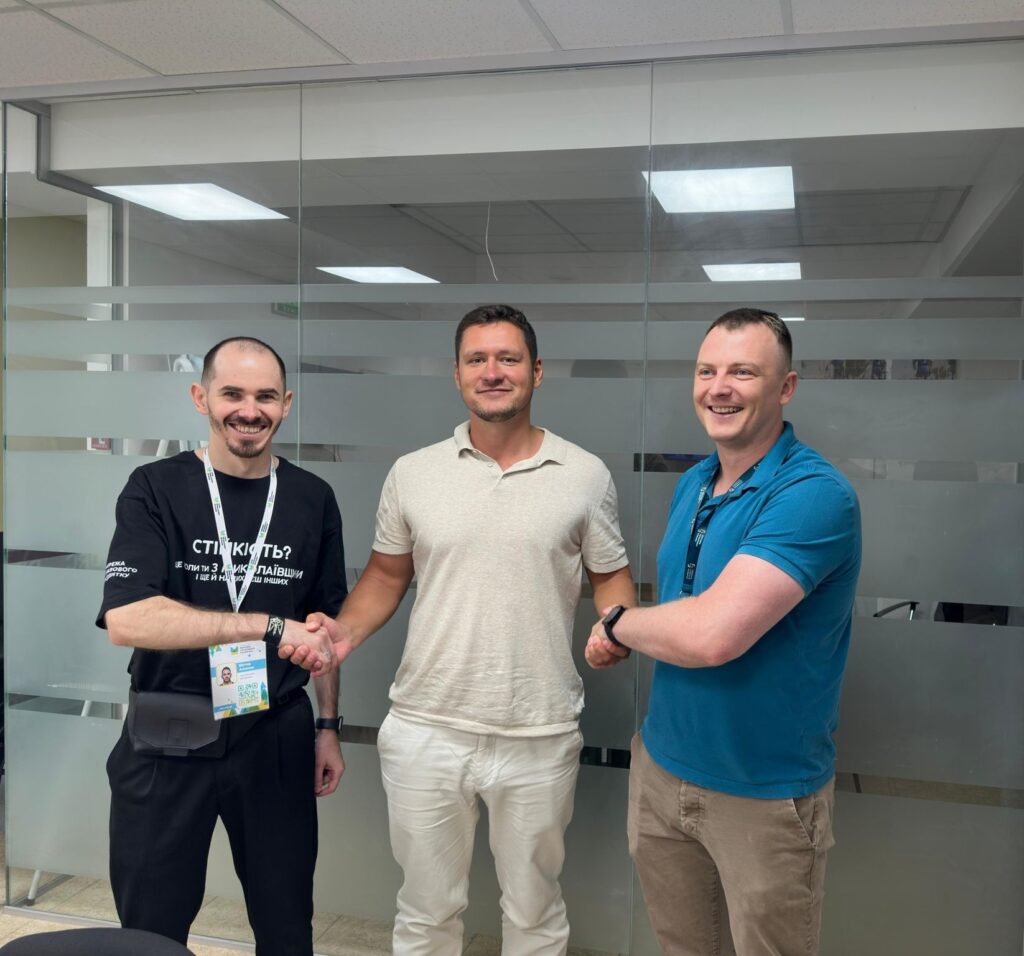
In the photo, left to right: LDN Programme Manager and coordinator of the WASH cluster in Mykolaiv oblast; Serhii Husak, coordinator of the WASH cluster in the south; and Maksym Bakai, project manager at the NGO Southern Development Strategy, which coordinates the WASH cluster in Kherson oblast. Photo of Serhii Husak from his LinkedIn page.
“We bring together cluster meetings and community representatives — starostas, social workers, managers of municipal institutions — who present their needs in the first person, so organisations can see immediately what exactly their assistance will be directed towards. Communities did take part in these meetings before our work began, but they were represented mainly by village heads or by representatives of military administrations. What we do is help the people directly responsible for meeting the need in their settlements to get into the room. We train them in meeting protocol and the basic principles of self-presentation,” says Viktor Alkhimov, Programme Manager at the Legal Development Network, who coordinates the cluster in Mykolaiv oblast directly.
For communities, this means three practical changes.
Needs become visible. LINK data is systematically brought to cluster meetings, so humanitarian organisations see not isolated requests but a broader picture of unmet needs in communities.
Communities gain a direct voice. Starostas, social workers and managers of municipal institutions can explain for themselves what exactly their settlement needs and why. LINK specialists help them prepare for the meeting and present their request clearly.
Resources reach the places where they are needed faster. When an organisation already has the relevant resource — funds, materials or equipment — the detailed information in LINK helps it quickly find a current need. Organisations can even book needs on the platform themselves.
In this way, localisation ceases to be merely a principle and becomes a concrete working mechanism: a need recorded in a particular village travels from the community to the humanitarian sector and stands a better chance of being met.
P. S. In June 2024, the Legal Development Network (LDN) launched a crowdfunding campaign, Recovery of The South of Ukraine , as part of the crisis response program #StandWithUkraine.
You can Recovery of The South of Ukraine |
If you have notices an error on the web-site, please, highlight the text and press ctrl-enter.
Print and place the Network's poster on a notice board in your entrance hall
Become a volunteer and assist others in finding problem solutions
0 800 331 113
from 10:00 to 17:00, toll-free within UkraineAsk a question, and one of the Network's experts will provide an answer.
Chat hours: daily from 10:00 to 16:00.
Ask questions via LawLink Bot in any convenient way. LawLink Bot is a smart and digital legal assistant created by the Legal Development Network.

The Legal Development Network implements comprehensive projects aimed at strengthening human rights, developing capable communities, and building sustainable tools for access to legal aid. We work at the intersection of advocacy, legal education, and local coordination of humanitarian response.

Support free legal aid in Ukraine. Your donation helps people affected by the war defend their rights in court and beyond.