Share on social media
Share
Tweet
Publication date: July 13, 2026
Since 2023, the Link local humanitarian response coordination team in Mykolaiv Oblast has collected and verified 3,819 humanitarian needs. Each of these needs pertains to a specific de-occupied village, household, paramedic and midwife station, or kindergarten where people are awaiting a response. We analyzed all the needs in the Mykolaiv oblast across eight sectors* (water, sanitation, and hygiene; shelter and non-food items; health care; food; heating, gas, and electricity; security; services; animal care and livestock farming) and outline the main trends: which needs are most prevalent, how requests are changing, and what partners should pay attention to.
Three clusters — water, sanitation, and hygiene (1,158 needs), housing and non-food goods (1,015), and healthcare (1,168) — together account for 87% of the oblast’s total needs. This is to be expected: basic living conditions always take precedence over other needs. However, the speed at which these needs are met varies significantly.
In the healthcare cluster, nearly 60% of needs have been met — the highest rate among the major clusters. This is largely due to the fact that medical supplies and care products are easier to standardize and deliver.
In the area of water, sanitation, and hygiene, the situation is more complex: 39% of needs have been met, while 31% remain unmet. For the most part, these are hygiene kits and diapers — consumables that require regular, rather than one-time, supplies.
Housing and non-food items fall somewhere in the middle: 34% of needs remain unmet, compared to 28% that have been met. Here, windows, roofing, and furniture take center stage — items that cannot be replaced with a quick shipment of goods.
The conclusion for coordination is simple: the three major clusters require not a uniform approach, but three different response rhythms — one-time for medical supplies, regular for hygiene, and longer-term and resource-intensive for housing.
Almost every cluster has an “Other” subcluster. This cluster contains the most specific requests from communities that do not fit into the standard classification.
In the area of water, sanitation, and hygiene, these include feminine hygiene products and water canisters. In the housing sector, they include financial assistance for household maintenance, flashlights, herbicides for cemeteries, and trash bins.
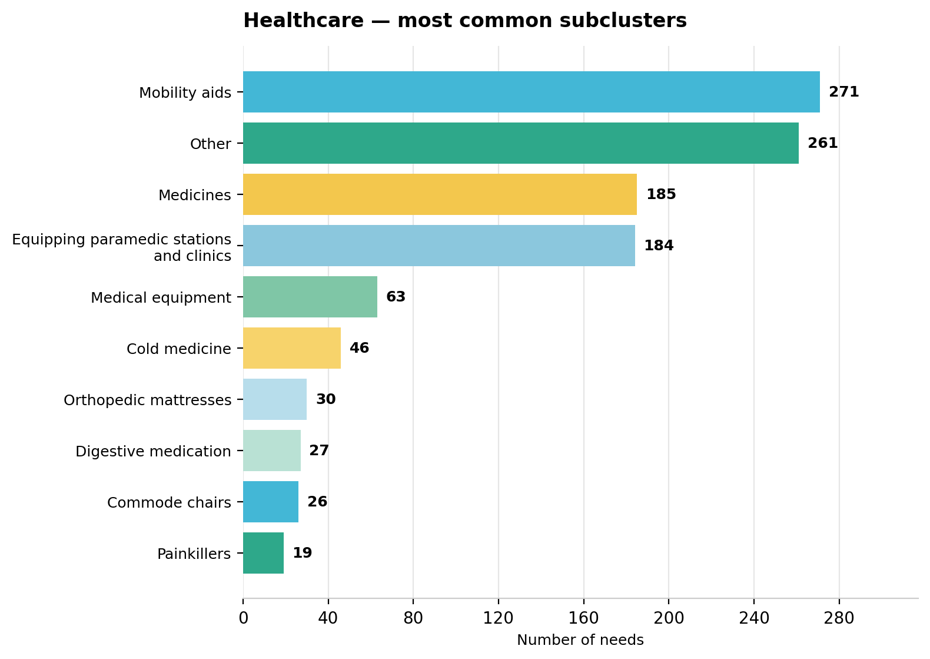
In the medical cluster, the “Other” subcluster accounts for 258 needs, or 24% of the entire cluster. Among these needs are bandages and antiseptics, disposable gowns and masks for social workers who provide home care, and commode chairs.
The “Other” breakdown is not meant to refine the database but rather to help find a partner who can truly meet a specific request more quickly.
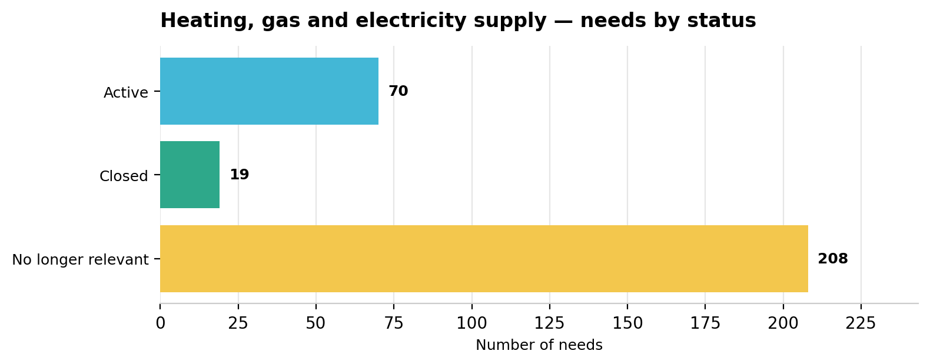
Firewood is the most common and accessible heating method for rural households. That is why demand for this type of fuel has historically dominated the heating, gas, and electricity cluster — 157 requests, accounting for 53% of the entire cluster over the entire data collection period.
But among the needs that remain relevant, the picture is different. 42 out of 70 active requests are for charging stations. Firewood, generators, and electric heaters follow.
Communities are asking less and less about “how to heat their homes” and more and more about “staying connected and powered” during power outages. For partners, this is a signal to review their list of aid items. Needs are changing rapidly, so it’s important to focus on the current profile of requests rather than on “how it was last year.”
The smallest cluster in terms of volume — “Services” (44 needs) — also shows the largest gap between need and response. Here, 52% of requests remain unmet.
The reason is not a lack of attention, but the nature of the needs: recovery services (34%), psychological support (26%), legal consultations, and repairs — none of these can be addressed with a shipment of goods. What’s needed here isn’t a warehouse, but a specialist: a psychologist, a lawyer, or a contractor who can physically travel to a specific village.
This area highlights the limits of typical humanitarian logistics — where the shortage lies not in warehouse resources, but in people willing to travel to the site.
3,819 needs — this is a constantly evolving picture. Three major clusters account for the bulk of the workload but require different response rhythms. “Other” encompasses specific, actionable requests. The energy profile is shifting from fuel to autonomous power sources. And service needs serve as a reminder that not every request can be addressed with a box of humanitarian aid.
The Link platform will continue to verify data from multiple sources so that humanitarian organizations can see not just the number of requests, but their actual content and status — and thus respond with even greater precision.
Note: The analytics highlight trends regarding unmet and overlooked needs in 11 de-occupied communities (181 settlements) in Mykolaiv Oblast as of July 7, 2026, which have been collected in the database since September 2023. Each need is verified from two or more sources, and the data is updated every two weeks.
*The names of the sectors (clusters) listed in the Link database do not correspond to the names of the humanitarian clusters used by the United Nations Office for the Coordination of Humanitarian Affairs (OCHA).
This material was prepared by the Legal Development Network in collaboration with the Czech humanitarian organization “People in Need” and with financial support from the Government of the United Kingdom.
The conclusions, interpretations of the collected information, and other content presented in this report reflect solely the views of the authors and do not represent the views of the project’s donors and partners.
P. S. In June 2024, the Legal Development Network (LDN) launched a crowdfunding campaign, Recovery of The South of Ukraine , as part of the crisis response program #StandWithUkraine.
You can Recovery of The South of Ukraine |
If you have notices an error on the web-site, please, highlight the text and press ctrl-enter.
Print and place the Network's poster on a notice board in your entrance hall
Become a volunteer and assist others in finding problem solutions
0 800 331 113
from 10:00 to 17:00, toll-free within UkraineAsk a question, and one of the Network's experts will provide an answer.
Chat hours: daily from 10:00 to 16:00.
Ask questions via LawLink Bot in any convenient way. LawLink Bot is a smart and digital legal assistant created by the Legal Development Network.

The Legal Development Network implements comprehensive projects aimed at strengthening human rights, developing capable communities, and building sustainable tools for access to legal aid. We work at the intersection of advocacy, legal education, and local coordination of humanitarian response.

Support free legal aid in Ukraine. Your donation helps people affected by the war defend their rights in court and beyond.