Share on social media
Share
Tweet
Publication date: July 13, 2026
Over the three years that the Link local humanitarian response coordination mechanism has been operating in the Kherson oblast, 6,129 requests have been recorded. This is nearly twice as many as in the neighboring Mykolaiv oblast. However, what sets the de-occupied Kherson oblast apart is not the number of needs, but the varying pace at which aid is being delivered within the oblast. An analytical review of eight sectors* (water, sanitation, and hygiene; shelter and non-food items; healthcare; food; heating, gas, and electricity supply; security; services; animal care and livestock farming) shows that while communities in the Kherson oblast have largely coped with some challenges, there is also a list of needs that have not even begun to be addressed.
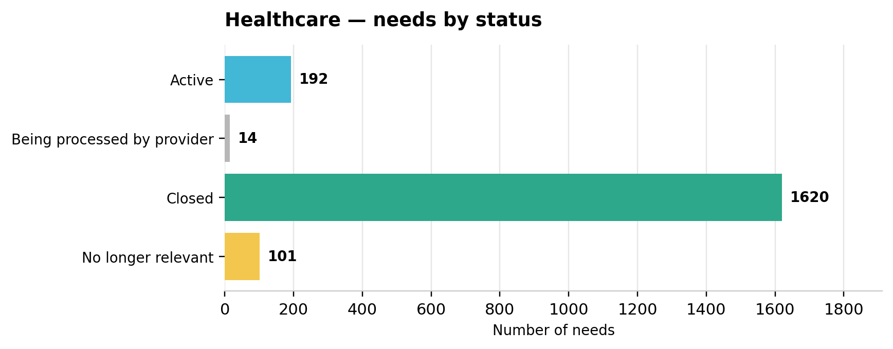
The healthcare sector is the largest in the oblast (1,927 needs) and, at the same time, the most successful: 85% of all requests have already been met, with only 9% remaining unmet. This stands in stark contrast to how the response is progressing in other clusters and shows that where there is a clear list of supplies — pain relievers, vitamins, mobility aids, medical equipment — partners are able to meet needs systematically and quickly.
29%, or 557 needs in this sector, fall under the “Other” subcluster. There are more requests here than in any other category. Communities report a need for the services of a physical therapist and for a number of specific medications.
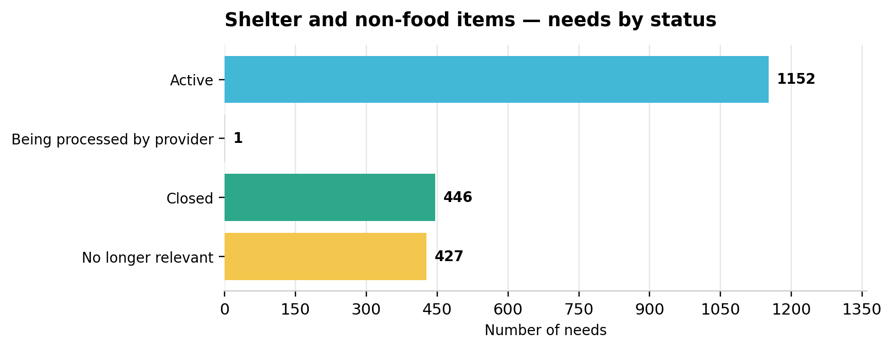
The housing and non-food goods sector in the Kherson oblast (2,026 needs, the largest cluster by volume) is an example that stands in contrast to the progress being made in the healthcare sector. Here, only 22% of requests have been fulfilled, while 57% remain unmet as of now. This cluster contains the largest number of unresolved issues in the oblast.
The largest group of requests falls under the “Other” subcluster: 285, or 14% of all the cluster’s needs. Overall, the housing cluster has the broadest range of requests — from pumps and concrete mixers for restoring flooded homes to children’s blankets and utility bill payments. Perhaps this is what complicates logistics and affects the pace at which needs are met.
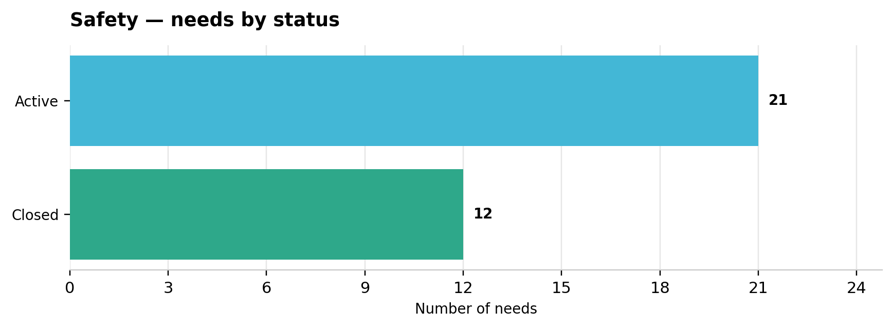
Security remains the smallest core cluster in the Kherson oblast — 33 needs. Of these, 12 needs, or 36%, have been met. At the same time, the majority — 21 needs, or 64% — remain unmet.
The needs in this area are quite specific: fire extinguishers (22), walkie-talkies (8), and surveillance cameras (3). These are specific pieces of equipment that may not seem significant in terms of quantity but are highly practical for communities.
This stands in stark contrast to the medical cluster, where 85% of needs have been met. Most security requests are high priority; however, this area has not yet been a focus for any partner.
Unlike the fuel profile in the Mykolaiv oblast, where most requests concerned the supply of firewood, in the Kherson oblast, the cluster of heat, gas, and electricity supply (464 needs) is more segmented. Firewood, gas cylinders, generators, briquettes, potbelly stoves, and pallets—no single type of fuel-related need accounts for more than 14%. The top three most common requests are charging stations, generators, and gas cylinders (16% each).
It is noteworthy that 42% of the needs in this sector are no longer relevant—the highest “obsolescence” rate among all clusters in the oblast. This means that some requests for fuel or equipment were made for a specific season or situation and simply did not wait long enough for a response.
The services cluster is small (68 needs) but offers an interesting comparison with the Mykolaiv oblast. In the Kherson oblast, 62% of requests were fulfilled, which contrasts sharply with the corresponding cluster in the Mykolaiv oblast, where only 2% were fulfilled.
Roof repairs, legal consultations, and psychological counseling—these requests in the Kherson oblast are clearly better met by service providers and contractors than in the neighboring oblast.
Among the 6,129 needs identified in the deoccupied communities of the Khersonoblast, progress varies significantly. While healthcare needs are being met rapidly, housing requests are only just beginning to be addressed. At the same time, security needs are still awaiting humanitarian organizations to come to the rescue, and energy needs are scattered across a dozen equally important areas. This indicates that a one-size-fits-all approach to aid delivery is not working here. Each cluster requires its own pace, its own partners, and specific attention to detail.
Note: The analytics highlight trends regarding unmet and overlooked needs in 11 de-occupied communities (181 settlements) in Mykolaiv Oblast as of July 7, 2026, which have been collected in the database since September 2023. Each need is verified from two or more sources, and the data is updated every two weeks.
*The names of the sectors (clusters) listed in the Link database do not correspond to the names of the humanitarian clusters used by the United Nations Office for the Coordination of Humanitarian Affairs (OCHA).
This material was prepared by the Legal Development Network in collaboration with the Czech humanitarian organization “People in Need” and with financial support from the Government of the United Kingdom.
The conclusions, interpretations of the collected information, and other content presented in this report reflect solely the views of the authors and do not represent the views of the project’s donors and partners.
P. S. In June 2024, the Legal Development Network (LDN) launched a crowdfunding campaign, Recovery of The South of Ukraine , as part of the crisis response program #StandWithUkraine.
You can Recovery of The South of Ukraine |
If you have notices an error on the web-site, please, highlight the text and press ctrl-enter.
Print and place the Network's poster on a notice board in your entrance hall
Become a volunteer and assist others in finding problem solutions
0 800 331 113
from 10:00 to 17:00, toll-free within UkraineAsk a question, and one of the Network's experts will provide an answer.
Chat hours: daily from 10:00 to 16:00.
Ask questions via LawLink Bot in any convenient way. LawLink Bot is a smart and digital legal assistant created by the Legal Development Network.

The Legal Development Network implements comprehensive projects aimed at strengthening human rights, developing capable communities, and building sustainable tools for access to legal aid. We work at the intersection of advocacy, legal education, and local coordination of humanitarian response.

Support free legal aid in Ukraine. Your donation helps people affected by the war defend their rights in court and beyond.